


Transcripción del podcast
Linda Lacina, Meet The Leader: Welcome to Meet the Leader, the podcast where top leaders share how they're tackling the world's toughest challenges.
In today's episode, we talk to Ayumi Moore Aoki of Women in Tech Global about patching the leaky pipeline in tech and science for women's careers.
Subscribe to Meet The Leader on Apple, Spotify and wherever you get your favourite podcasts. And don't forget to rate and review us.
I'm Linda Lacina from the World Economic Forum, and this is Meet the leader.
Ayumi Moore Aoki, Women in Tech Global: 2.6 percent of global funding went to all-women teams. It's good to have accelerators, yes it's good to have mentoring, to have training, but they need funding.
Linda Lacina, Meet The Leader: It will take another 123 years to bridge the gender gap. That's all according to our latest edition of the World Economic Forum Global Gender Gap Report. And at the same time, women are missing out on careers in the AI sector and they're more likely to lose their jobs to generative AI.
What is needed to fix that? Ayumi Moore Aoki has some thoughts. She is the founder of Women in Tech Global. That is an organization headquartered in Paris that operates in over 60 countries with more than 250,000 members all around the world, all to boost opportunity, access and drive skill development in science and technology.
I talked with her this May at the World Economic Forum Global Technology Retreat in San Francisco. She told me about the leaky pipeline in tech that exists at every stage in a woman's career, makes it harder to get and retain women in these fields. And she also shared what leaders can do to counteract this.
But she also shared with me where progress is being made and how our AI-powered world could present a special opportunity for women leaders, provided they learn to leverage both their tech savvy and their empathy. She'll talk about all of that as well as her personal journey from her early days in South Africa during apartheid to the simple piece of advice she got when she founded Women in Tech – advice that can help anyone move faster towards a big goal.
We'll get into all of that, but first, she'll share the state of women in tech.
Ayumi Moore Aoki, Women in Tech Global: So the state of women in tech today is quite promising. So, we are up two points, from 26% two years ago to 28%. However, we are still less than one third of the workforce. So that means that we still have a lot, a lot of room for improvements.
Linda Lacina, Meet The Leader: What is going great with that? Like what are the areas where we're seeing a lot of success? Are there certain fields where we are seeing success or certain regions? What's going great?
Ayumi Moore Aoki, Women in Tech Global: So the science field is one that's really, really going up. Whether it's in AI, in research, in science, we have many, many more women scientists coming to the place, so this is a great thing. In tech, however, especially mostly in the software and the hard tech, women are still very much underrepresented, including in AI.
There's a leaky pipeline in very different stages across the world
”Linda Lacina, Meet The Leader: Our Gender Parity in the Intelligent Age report found that there's sort of an uneven situation happening in certain ecosystems, meaning that there are sort of clusters in one region and maybe not in another, and then an imbalance across different economies, right? What problem can that have when maybe we've got some folks with expertise in one place and not in another? What problem could that cause?
Ayumi Moore Aoki, Women in Tech Global: Well, we have the problem for the region itself, right? Because they're going be struggling to have women represented in a certain area. However, what I do find positive is that we can really, really learn from the different areas in economies around the world, what is working in that region and how they manage to get there. And then we can really exchange best practices.
For example, if you look at the Middle East right now, in North Africa and the Middle Eastern countries, women graduates in science and in tech fields and STEM fields, they are gender equal. And in some countries, they're even more women graduates than men. So you can see there's a lot of progress in that sense. Something that is not true when you look the European graduates or also in North America. We look at there are about 22% also of women graduates in France and Europe.
So, we can learn best practices from them. And the difficulty is converting these graduate students into the workforce. So, we see that in Europe, and in the US as well, and also in Latin America, there is this conversion which is happening where they are going to the tech fields, going to tech workforce, where they still represent less, but you also see that the graduates are not so much.
However, in the Middle East, where there's a lot of graduates in the fields, they don't convert into the workforce. So, you see that there's a leaky pipeline in very different stages across the world. But at the end of the day, we're still not very much represented. But as I said, it's positive because things are moving forward slowly but surely.
Linda Lacina, Meet The Leader: And when we talk about some of these things with the leaky pipeline and maybe there's not maybe enough in certain fields, you know, what contributes to this problem? What are these forces that maybe are headwinds to this?
Ayumi Moore Aoki, Women in Tech Global: Well, if there was only one thing, it would be easy to tackle it. It's a number of these things that have come together. It comes from stereotypes, from gender bias, from unconscious bias, from what is a good profession for a young girl or for a young boy.
And this changes the biases throughout your career, whether when a child is born, the kind of toys they're going to be given. And then at school when the teachers are going to be thinking that girls are more for the arts and the literature and the boys perhaps for physics. These are still very present today and I even feel it already with my, with my children. I've got two boys and two girls and you see that the way that the teachers are guiding them to choose career paths and higher studies, it goes completely in that way.
Linda Lacina, Meet The Leader: And this kind of dovetails into us talking a little bit more about these different stages of the pipeline. You just talked about education and sometimes in the early days, maybe people are steered one way or another and maybe not even on purpose, just maybe even for sort of cultural habits and things.
What can be done maybe at the education stage to sort of help fix these little holes in that pipe? What can be done at that stage?
Ayumi Moore Aoki, Women in Tech Global: So, I can give you an example of what we're doing right now in France, because we have seen studies and empirical evidence has shown that the age that where there's a lot of dropouts from women's interests, girls' interests in STEM education is about between 14 to 15 years old. And this is a very crucial age.
So, what they are being done is specific like boot camps and workshops for women, for girls. So, girls between that age. But also, to their parents and to the teachers, because we to train and we have to inspire those girls at that age. But also the parents, because if they go home and they don't get the support from the parents and if the teachers that are teaching the classes and guiding them, they also don't believe in that, things don't work. So, we have to have a collective effort and collective work to guide those children to the higher education.
Linda Lacina, Meet The Leader: And what makes those programmes work, right? Because there's been plenty of programmes with girls in tech and we still haven't sort of bridged that gap. So, the most effective programmes for girls in tech, what features do they have to have?
Ayumi Moore Aoki, Women in Tech Global: I think the ones that inspire the girls. There was a study done on different ways how you could inspire girls, how you can get more results in having girls in education. And there were two different groups. One was, they had speakers that was saying, oh, we need more girls because girls are underrepresented, et cetera. And the other group, giving them role models that would inspire them on how these role models became successful and how they changed the world.
And you can see that after the courses, The girls who attended the sessions which was an inspirational session, they were much more inspired to go to those higher education. So, you have to tackle the problem, I think, by inspiring the women to go to that thing, saying, okay, how they can change the world. Tech for Good, for example, those are the things that generally they talk more to the girls.
Linda Lacina, Meet The Leader: What sort of can go sideways? What can go wrong at early career that we might start losing women at even maybe their first couple of years in their field? What goes wrong and how can we fix it?
Ayumi Moore Aoki, Women in Tech Global: It’s, I think it's the environment, right? When you are looking at an environment that is going to be welcoming for women, you can feel it right away. And this you can see by the rate of the dropout of the women going out of the field is much higher than the men leaving the field.
Also, if it comes to an age where women, maybe they want to found families. Like structure within, within the company is going to be something that's going to push them to come back into the workforce.
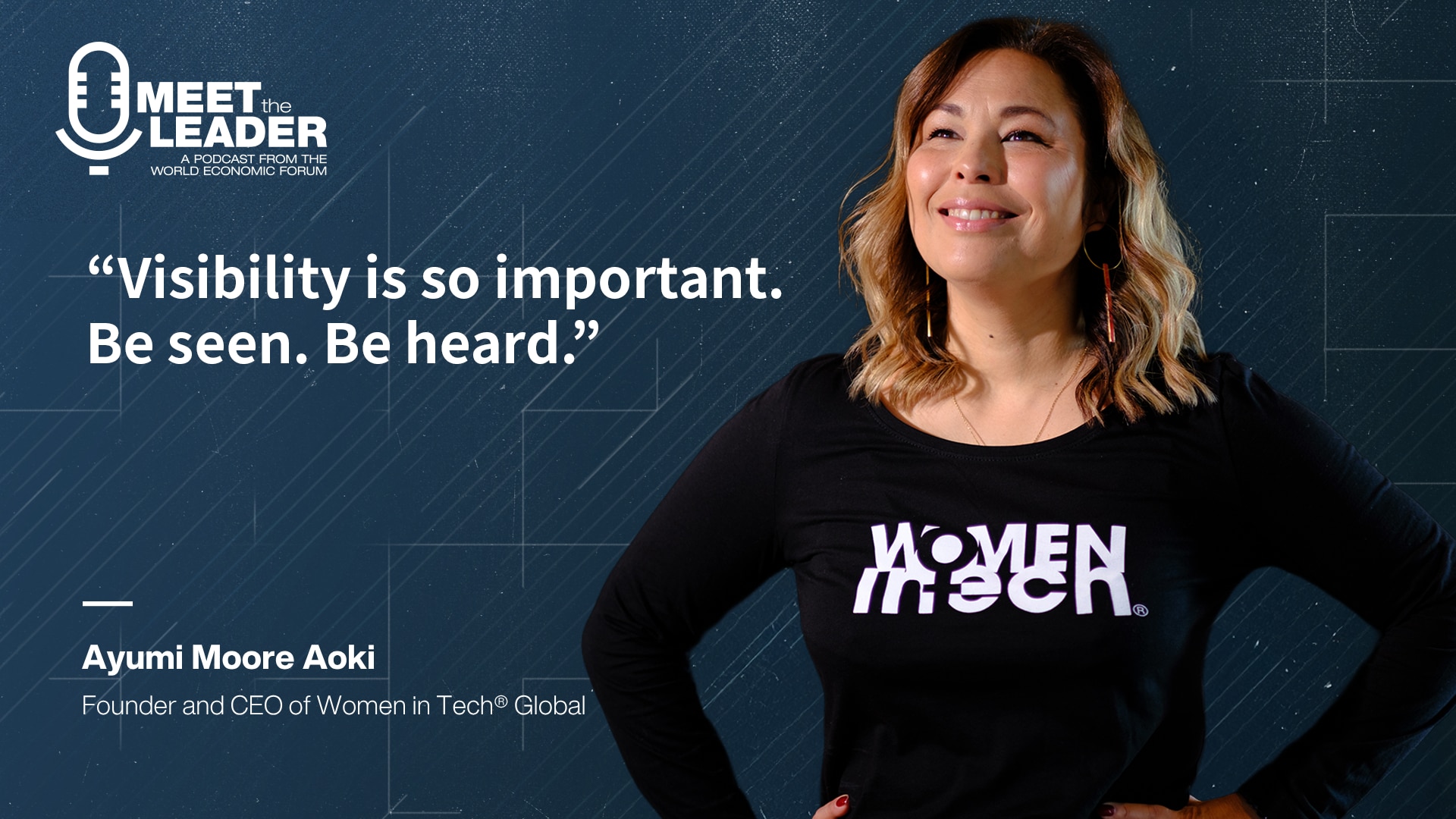
And also mentoring. We say, yes, yes, we need mentoring, we need women to be visible. I think visibility is something so important. Be seen, be heard and make sure that the doors are also opened.
Visibility is so important. Be seen, be heard and make sure that the doors are also opened
”Linda Lacina, Meet The Leader: And if I'm a leader listening to this and I want to do more, what's a question they can ask themselves about their own workplace or their teams to kind of help bridge any gaps that they may not even realize are there? What can a leader do?
Ayumi Moore Aoki, Women in Tech Global: So first of all, they have to look at the team, look at them around. Is it gender equal? Are they women, are they men? And even if they are, what are they bringing to the table?
Sometimes women, they feel that they don't belong or they're not being heard. Ask them questions. When you're in a meeting, you have everyone's views are being seen, whether you're a woman or a man, but try and get the views from everybody. And if they don't dare to say, ask questions and make sure they're there.
Linda Lacina, Meet The Leader: And is there something special that needs to happen at late career for those women to make sure that they can maximize their talents and skills to an organization or even to their field? What can we make sure that doesn't stand in their way?
Ayumi Moore Aoki, Women in Tech Global: So first, we have to have more women on board in the leadership positions. When you look today, it's only about 10% of women are in those levels [among Fortune 500 companies]. So having more women, it is important because I think the direction and the culture of a company comes from the top down. So, we have make sure that they are walking the talk.
And so having women leaders at that level, that will make sure that they're going to be a role model for the other women in the company. And they're going to be making sure as well that there are going to be more women that are going to be trained and are going to be inspired to come up the ladder. At least they're going to be have, giving the same chances to everyone.
Empathy is one of the main skills AI cannot learn
”Linda Lacina, Meet The Leader: LinkedIn had its recent Workforce Confidence Index, and it found that women acknowledged that it would impact their jobs, but also that AI would fuel the importance of soft skills. So soft skills don't go away because of the ascendance of AI. What are the soft skills that AI can't learn, in your opinion?
Ayumi Moore Aoki, Women in Tech Global: Ah, for sure, I think it's empathy. Empathy is one of the main skills that they cannot learn and discernment as well.
Linda Lacina, Meet The Leader: How can leaders make sure that they can keep their soft skills sharp? What would you suggest?
Ayumi Moore Aoki, Women in Tech Global: By having diverse teams, for sure. Keeping the human in the centre of any team, not the tech. Tech is important, but I think the human side, the relationship side, this is what makes a team thrive on its time. And this is the core of every successful business is a team.
Making sure that there is a diverse team and then they can really foster, I think, conversations, open dialogue, and questioning how the personnel, how do they feel? Are they happy in there? How can they improve? And these are the things that can only come from the leadership.
Linda Lacina, Meet The Leader: You mentioned that maybe women aren't as well represented in AI as men, but they might be better prepared for a world that is giving more emphasis on soft skills. Is that correct? Is that assumption correct? Or what would you say? What kind of advantage would women have regarding soft skills as AI grows?
Ayumi Moore Aoki, Women in Tech Global: I think women do have an advantage with the soft skills about empathy, because they nurture and has been proved in many, many studies showing how women have this emotional side that has empathy in it. And so, I think on that sense, yes.
But if you look at AI itself, AI is just prediction. There's no ghost behind the machine. It's just a formula of prediction. And so, what’s going to be coming out from the questions is a series of prediction that's going to be coming together. At the end of the day, the results they give for the human to decide whether that answer is ethical, if it really represents society, if it represents the culture and the values of the company.
And this discernment and this decision-making can be done only by humans, right? They take the decision, the decision procedure. And I think women are good in making these decisions because they have empathy.
Linda Lacina, Meet The Leader: You are the founder of Women in Tech Global. What is that and what problem does that solve?
Ayumi Moore Aoki, Women in Tech Global: So Women in Tech Global, we are an organization with headquarters in Paris, but we are present in over 60 countries around the world with teams. And we try to empower women in many different ways. We have four pillars, education, business, digital inclusion and advocacy. We have a talent hub and we try to prepare women from the classroom all the way to the boardroom to come into the STEM fields.
Linda Lacina, Meet The Leader: And you guys launched this thing called The Osaka Protocol. What is that and what impact is it helping to make possible?
Ayumi Moore Aoki, Women in Tech Global: So, the Osaka Protocol is a multilateral framework where we're bringing different actors to the table where they are committing to help bridge this gender equality gap that exists in STEM fields. But in a very concrete way. It is not just pledging, say, yes, we want to have more women in education, more women, in the digital fields, more women into the workforce. They have to say how they're going to be doing it, right. So, they pledge, we are going to be training 100,000 women or 200,000 woman. But collectively we're going to be impacting 100 million women by 2030.
But I think it will raise more awareness on how important it is to have more women there. Because not only it's important for the business, but also for women to be financially independent and for the companies themselves to be able to perform better. I think 100 million is something that can start causing systemic change. And I would like to see us moving from a 28% representation of women in the workforce all the way up to 45%.
Linda Lacina, Meet The Leader: Well, what sort of prepared you to run Women in Tech Global, in your background that sort of poised you to make you ready for this?
Ayumi Moore Aoki, Women in Tech Global: I don't think we are ever really ready for it. I was an entrepreneur before. So I think being an entrepreneur, knowing that you have to go over walls, open doors, climb windows, go over the roof, because it's hard, it's very hard. But I think if you're an entrepreneur it's something that can really help you.
It also comes from my background. You know, I grew up in South Africa in Johannesburg where it was still apartheid, where we had to fight different kinds of biases of discrimination. There was racial discrimination, but there was also a lot of gender discrimination back then. And so, this is how I grew up. And, so having to fight those stereotypes, you know, at school, at sport, it really forged me a character to not become a victim in any situation and to fight for the rights.
Linda Lacina, Meet The Leader: You mentioned walls, hitting walls. What's a wall that you hit that was really shaping for you? Where you really learned a lesson from it and it changed maybe how you solve problems or how you make decisions. Tell me a bit about that.
Ayumi Moore Aoki, Women in Tech Global: Well, I've had many walls, every day there's a wall, but maybe like the very first one, when I founded Women in Tech, I thought this was such an important organization and such an important movement because we are there to empower women that we needed so much needed. So I thought I was going to be getting help from so many partners, from so many sponsors, from so many people. When I organized my first event, I thought I would have partners and sponsors behind me and nothing, not one euro. So I had to bring out, you know, makeup, like, very big awards event all by myself, self-funding, selling t-shirts with children.
So, it was a difficult, but you know what doesn't kill you makes you stronger. Everything is a small fight, but it pays off at the end.
Linda Lacina, Meet The Leader: Is there an advice that you would give to yourself, looking back, tell yourself anything? What would you tell her?
Ayumi Moore Aoki, Women in Tech Global: I would have used my voice much earlier. I found my voice at a later stage and it was a journey to find that. I don't regret anything in my life. The only thing I do regret is when I didn't say things I should have said at the right time. Don't think about it unless like in really anger but you have to take the opportunity. Tomorrow you might not have it. So, take it when you have it and say it.
Linda Lacina, Meet The Leader: What do entrepreneurs need right now?
Ayumi Moore Aoki, Women in Tech Global: If you look at the global statistics of global VC funding, last year, so 2024, the most recent, only 2.6% of global funding went to all-women teams. 2%, that's ridiculous. Yes, it's good to have accelerators. Yes, it's good, to have mentoring, to training, but they need funding.
Linda Lacina, Meet The Leader: It's been an ongoing issue, women and funding, they've gotten a fraction of it, to the point where some people may have tuned this out, doesn't seem new anymore, it's not new and fresh. How can we get people to pay attention?
Ayumi Moore Aoki, Women in Tech Global: I think the more that the women are going to be changing the world, if I may say, whether they make unicorns, but also advancing in science, and because there are more and more women coming to science and finding, tackling global problems, these are the ways that they're going to be really changing the narrative.
Knowing that women are behind in giving visibility to women and making sure that the names are out there, that we put the spotlight on them, not only on the women, but, also, on the inventions and innovations that they do. Because we don't have to reinvent the wheel, I think putting them forward will inspire and also give tribute to the remarkable work that's being done.
Linda Lacina, Meet The Leader: You're a self-taught coder. What have you been teaching yourself now? What's the latest thing you've been learning?
Ayumi Moore Aoki, Women in Tech Global: So I started a doctoral degree. So right now I'm a doctoral candidate and I'm learning to really learn. I'm doing research. So this is something that's really opening my mind in a great way. I think it's one of the best things I've done, yeah.
I'm doing research and I am working right now on tech diplomacy and its impact and how it can impact and influence gender equality and women empowerment.
Linda Lacina, Meet The Leader: Is there a fact that has been really surprising to you from what you've learned in your research so far?
Ayumi Moore Aoki, Women in Tech Global: Yes, I did quantitative research on gender bias in AI. You know, we talk about, a lot about it, but then to find the data and to find, you know, real proof, it was quite something.
So, we found there was gender bias in large language models. And depending on the language model in the AI platforms, I'm not going to cite them, but we put together like five different ones. And depending on the ones, they were not always the same bias. So, there are some platforms that are more biased than others, and there are languages that are more biased than others.
So, you have English is a neutral language, so you find less bias. However, if you go to Latin languages like Portuguese or French or Spanish, higher. Also languages like German, which is not a Latin language, but is a gendered language like Russian and Arabic, you also find. So, depending on the country, depending on the databases that they get, and depending on the platform you use, you have more or less gender bias.
Linda Lacina, Meet The Leader: People will be maybe managing AI agents as opposed to maybe people, maybe even managing multi-agent systems. It was hard enough to manage people, never mind this ever-changing technology. What skills will people have to develop so that they can better manage either AI agents or these multi-AI agent systems?
Ayumi Moore Aoki, Women in Tech Global: So obviously you have to learn how to prompt, you have learn how to define your question in a way that can be easily comprehended. But not only prompting, yes you have ask the questions, but most importantly you have to verify the answer. Don't take anything that's just given to you as if it was the truth. Go check the answer and check the data where the answer was got.
I know it's a lot of work but, honestly, it's so important because, for example, even for my research work, I would say, okay, give me the top academic papers on this field. They would give me a top. I said, give the references. They gave me the references. But if you click on it and you go look at the data, it doesn't exist, it was false.
So, you have to check every single step until you make sure that the answer -- and this is vital for us to have the right information -- you have to check. So, prompting right and then checking, checking and rechecking. Misinformation can lead to drastic consequences, because if you are taking, making decisions with wrong information, then things can get bad.
Linda Lacina, Meet The Leader: Is there anything that you're worried about? You think, gosh, this is something people really need to focus on. In your mind, if they could prioritize one thing, one big gnarly problem to be solving, what is that?
Ayumi Moore Aoki, Women in Tech Global: Honestly, what's worrying right now is all the backlash that's done on gender equality, on diversity. For me, that's something very worrying. Every time you go like one step forward, you go two steps back.
But at the same time, I think it's important to see the true face of people and companies and to know what the values are. And I think that today, integrity was one of the hardest things to find. And when you find it, whether it's in the person, a structure, an organization, this is something very valuable. And this is the place where you can count on and you have to invest and you have to be able to get the best people there because those are the ones that's worth it and they can make a difference.
If it is in the DNA of an organization, to be open, to be diverse, to be welcoming to people of all genders and natures and backgrounds, this brings richness
”Linda Lacina, Meet The Leader: What is a tactical way that leaders who want to still bridge these gaps and do some of these efforts, maybe these programmes have gone away, maybe these quotas have gone way, whatever. What's a tactical that a leader can still make sure that they are being inclusive and that they're kind of keeping their eye on these equality goals?
Ayumi Moore Aoki, Women in Tech Global: It goes all the way from the hiring procedure that they've got in the companies to the environment that they are creating in the company. I think if it's in the core, if it is in the DNA of an organization, to be open, to be diverse, to be welcoming to people of all genders and natures and backgrounds, this brings richness, right?
So, I think it shows the open-mindedness and intelligence of the leader of the company and also the integrity they have.
Linda Lacina, Meet The Leader: Is there something that you do now that would not have occurred to you at the start of your career?
Ayumi Moore Aoki, Women in Tech Global: I'm very data oriented right now, so I check the data. So even when I'm reading a paper and they say they mentioned like a number, I'll say, yeah, they say this, but what is it behind? And so many times, even like in big papers, you go check the source, it doesn't say the same thing that they are meaning.
So, I try to find the source of the data and interpret it myself. And then you see that sometimes our data is dirty, so you can make it say so many different things. So, finding the core and then making your own decisions about it, you know, like your own thoughts, your own reflections, I think that's something super important.
Linda Lacina, Meet The Leader: And is there a book that you recommend?
Ayumi Moore Aoki, Women in Tech Global: This book is called Who Not How? And I think it's a wonderful book because it shows how you don't have to know how to do everything. Things can be done by surrounding yourself with the right people.
Linda Lacina, Meet The Leader: And how would someone change after they read that?
Ayumi Moore Aoki, Women in Tech Global: They change because they look for people that can help you in every single state of your life, to facilitate your life and to make you be able to perform better and to do more.
Linda Lacina, Meet The Leader: Is there one theme that you think is going to define the next 12 months in technology?
Ayumi Moore Aoki, Women in Tech Global: Sovereignty. The instrumentalization of AI and of nations, there's this cold war right now on AI. And I think that the balance of digital sovereignty and of collective work and of innovation is going to be central, not only for the main superpowers that we have, like East and West, but also bringing into consideration the Global South that I think is going to be coming up. And we have to make sure that we hear voices, not only, there's going to be this paradigm shift in power and influence.
Linda Lacina, Meet The Leader: And for listeners who maybe are not familiar, can you define digital sovereignty for us?
Ayumi Moore Aoki, Women in Tech Global: Digital sovereignty is a state nation, ownership of the data of the rights that encompasses all the digital frameworks, for example, AI and how that data in the nation state is being owned, it's being used, and can be exchanged.
Linda Lacina, Meet The Leader: And if we get digital sovereignty right, what does the world look like?
Ayumi Moore Aoki, Women in Tech Global: I like to see this. It's almost when globalization works right. If you look at digital sovereignty in an ethical way, we're making sure that we're putting the human and the ethical side at the centre, and it's being respected by all the countries or the nation states.
I think we're talking about peace and about security and about a world that's more stable, that's going be able to work together in many different ways. If you were able to bring that together, I think peace is possible and many things are possible.
Linda Lacina, Meet The Leader: Is there a piece of advice that you've always been grateful for?
Ayumi Moore Aoki, Women in Tech Global: Yes, it was this lady who said to me, when I told her my dream about women in tech and about this world where there's going be more gender parity, she said to me, once you find your dream, you have to be able to articulate it and explain it in a very simple way so that people understand what it is. And you have inspire them. This way they will be able to help you and to achieve things in a much faster way.
Linda Lacina, Meet The Leader: That was Ayumi Moore Aoki. Thanks so much to her. And thanks so much you for listening.
To read our recent Gender Parity in the Intelligent Age report, go to the show notes of this episode. We'll have that and our recent edition of the Global Gender Gap Report.
And to listen to more podcasts, including my colleague's podcast, Radio Davos, go to wef.ch/podcasts. This episode of Meet the Leader was produced and presented by me with Jere Johansson and Taz Kelleher as editor, Edward Bailly as studio engineer in San Francisco and Gareth Nolan driving studio production.
That's it for now. I'm Linda Lacina from the World Economic Forum. Have a great day.
While prospects for women in tech and AI have improved, women still comprise just a fraction of the tech workforce. Ayumi Moore Aoki is the founder of Women in Tech Global, an organization with a presence in over 60 countries around the world, one designed to empower women in the sector. She shares how a leaky talent pipeline makes opportunity harder to seize, what's needed at each stage of women's careers to bridge gaps and what leaders can do to ensure they make the most of their team's talents. She’ll also explain how women can distinguish themselves in AI and the one topic that will define that technology in the year ahead. Lastly, this serial founder also details how her background has prepared her to run WTG, from her time in South Africa during apartheid to her lessons learned as an entrepreneur.

Una actualización semanal de los temas más importantes de la agenda global

Nilmini Rubin
3 de marzo de 2026


