Cómo los clústeres industriales de China impulsan el crecimiento, la competencia y la sostenibilidad
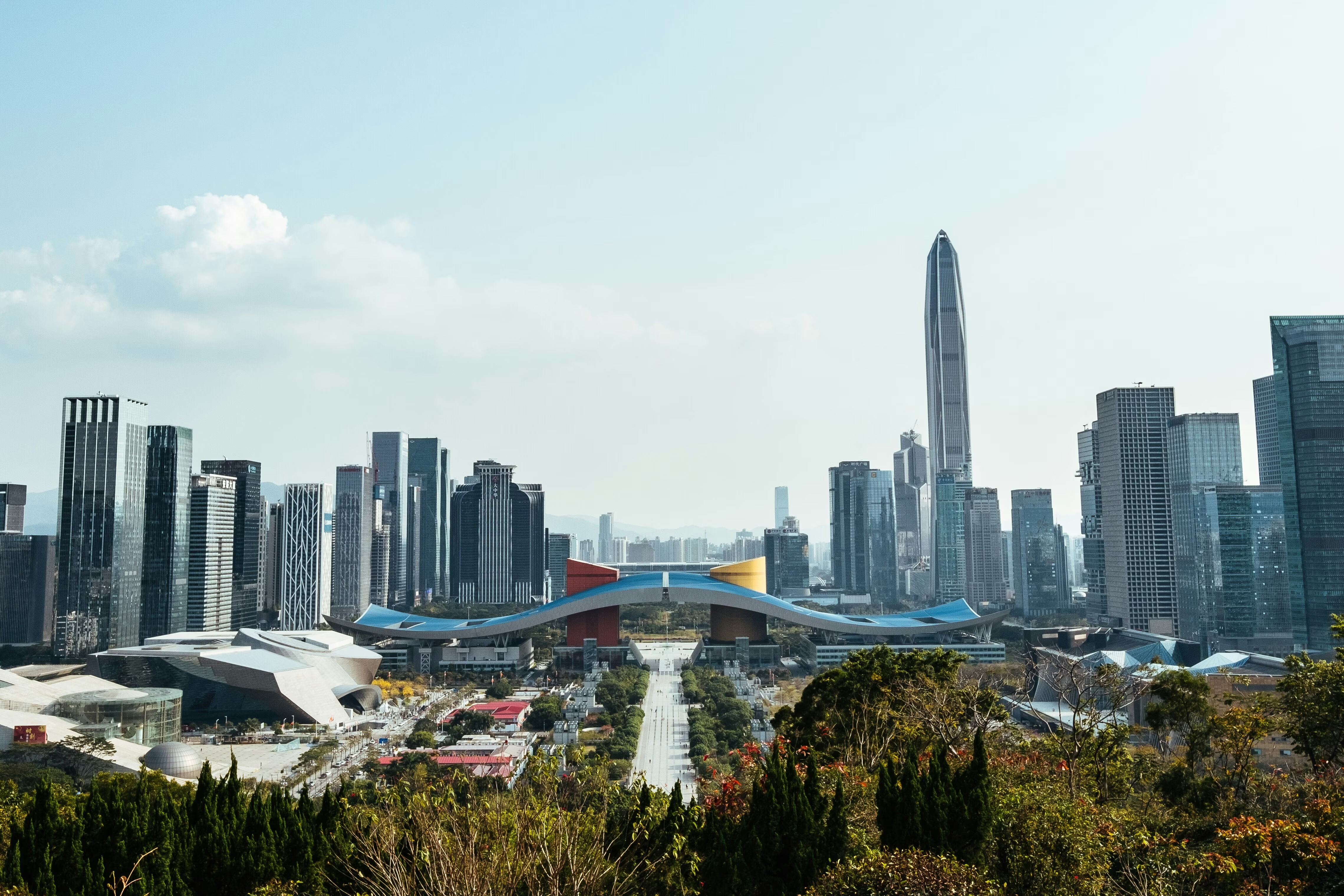
El mundo puede aprender mucho sobre sostenibilidad de estos modelos de organización. Image: Robert Bye/ Unsplash
Chen Weirong
General Manager (President), Energy Development Research Institute, China Southern Power Grid- Los clústeres industriales de China son el punto donde convergen el crecimiento económico y la responsabilidad ambiental.
- Existe un creciente interés internacional en cómo estos clústeres abordan la energía y la transformación industrial.
- El Foro Económico Mundial, a través de su iniciativa Transitioning Industrial Clusters, busca conectar las prácticas chinas con sus pares globales y fomentar comunidades de intercambio de conocimiento.
China's industrial clusters are where economic growth and environmental responsibility converge. By concentrating on energy-intensive production, infrastructure and employment, China's industrial clusters account for a significant share of the country's GDP, jobs and emissions, while remaining central to regional competitiveness and innovation.
For economies navigating the dual challenge of decarbonizing industry and sustaining growth, industrial clusters can be a practical entry point and, in some cases, a critical opportunity. By enabling organizations within the same cluster to coordinate energy systems and governance levels, they can serve as platforms for more efficient, system-wide transformation that extends beyond decarbonization to include productivity, resilience and long-term competitiveness.
Across economies, industrial clusters face a set of shared transition challenges. Their high and concentrated energy demand makes them major sources of emissions and these long-lived, capital-intensive assets lock in carbon-intensive production pathways for decades. At the same time, industrial clusters enable multiple organizations to share basic infrastructure, making coordination of energy systems, data sharing and investment decisions inherently complex.
These structural features often result in system-level inefficiencies and they explain why there is growing international interest in China's cluster-level approaches that also encompass energy and industrial transformation.
Why are China’s industrial clusters so successful?
China is the world’s largest manufacturing economy and energy consumer. More than 80% of its industrial enterprises operate within various types of clusters and development zones, accounting for over half of its national industrial output. This concentration makes China's industrial clusters a major source of emissions, but also a powerful lever for change.
China has placed industrial clusters at the centre of its industrial and green transition efforts, positioning them as piloting ecosystems of different integrated solutions: from accelerating clean power and technology development, to informing policy and market mechanisms.
Accelerating electrification and clean power
Electrification in China has expanded across key industrial processes, including its steel, petrochemical, non-ferrous metals and building materials sectors. According to International Energy Agency data, the share of electricity in China’s industrial final energy consumption increased from 25.5% in 2013 to 35.3% in 2023, exceeding the global average of 30.0%.
At the cluster level, some coal-fired units are being upgraded or replaced with gas-fired or electric systems. Distributed renewable generation is deployed on rooftops, façades and available land, complemented by integrated source–grid–load–storage models, direct green power procurement and smart microgrids. Participation in green electricity and green certificate markets provides additional supply options for clean energy sourcing.
Some clusters are experimenting with very high shares of clean energy by combining on-site renewables, storage and market-based procurement. These experiences offer practical insights into how reliability requirements can be met while reducing carbon intensity. This combination of on-site generation, grid integration and market procurement offers a replicable model for other industrial economies.
Using policy signals to guide transformation
Rather than prescribing specific technologies, national policy frameworks increasingly act as signals steering investment towards advanced and lower-carbon activities. China’s Industrial Structure Adjustment Guidance Catalogue separates industrial sectors into encouraged, restricted and phased-out sectors. This influences cluster planning, project approval and access to finance. This classification reflects the principle of guiding social resources towards high-quality development, while limiting high-consumption, high-emission and low-value activities.
Local governments use these principles in ways that reflect regional resource endowments and industrial bases, supporting structural upgrading while managing transition risks. This approach allows experimentation and differentiation across clusters, rather than a one-size-fits-all pathway.
Strengthening market mechanisms
Market-based instruments are playing a growing role in shaping decisions within industrial clusters. China’s national carbon emissions trading market, initially covering the power sector, has expanded to include steel, cement and aluminium, enabling emissions reductions where marginal abatement costs are lowest. More than 60% of China’s CO₂ emissions are now covered by the national emissions trading system, bringing them into market-based carbon trading.
Green electricity markets are also scaling rapidly. In parts of southern China, annual trading volumes of green power and certificates have reached over 450 billion kilowatt-hours, with aluminium, steel, chemicals, electronics manufacturing and data centres among the largest consumers. These mechanisms embed environmental performance into core business decisions, rather than treating it solely as a compliance obligation.
Energy performance contracting and energy management services further support efficiency upgrades by allowing professional providers to invest in, retrofit and operate cluster-level energy systems. This reduces upfront costs for enterprises while sharing efficiency gains.
Scaling technology and digital solutions
China has invested heavily in green and low-carbon innovation. In 2024, green and low-carbon patent publications by Chinese applicants reached around 120,000, an increase of 18.9% year-on-year, accounting for nearly half of global growth in this area. By the end of 2024, valid green patents exceeded 280,000, reflecting sustained investment momentum.
Large-scale equipment upgrades are underway across key sectors, including electric boilers, kilns and furnaces, as well as high-efficiency motors, pumps, compressors and transformers. In 2024, over 20 million pieces of equipment were upgraded, delivering energy savings equivalent to approximately 25 million tonnes of standard coal.
Digital platforms increasingly support these efforts. Analysis of tens of thousands of emissions reports enables more granular carbon management, while smart-energy management systems provide real-time monitoring and optimization across cluster infrastructures.
China’s industrial clusters provide lessons for system-level transition
China’s experience with industrial clusters highlights how system-level transition depends less on isolated technologies and more on coordination across organizations, infrastructures and governance levels. Within clusters, shared energy systems, digital platforms and circular solutions can lower costs and risks, enabling progress on decarbonization, alongside competitiveness, jobs and regional development.
Equally critical is multi-level governance. Clear alignment between national policy direction, local implementation and enterprise action helps reduce uncertainty and accelerate adoption at scale. As China enters the next phase of its industrial transition, deepening coordination within and across clusters will be central to sustaining momentum.
As part of this effort, the World Economic Forum is working in China via the Transitioning Industrial Clusters initiative to support more clusters in joining international knowledge-sharing communities, helping to connect Chinese practices with global peers. While rooted in China’s specific context, these cluster-level insights offer valuable reference points for other economies pursuing system-level industrial transition.
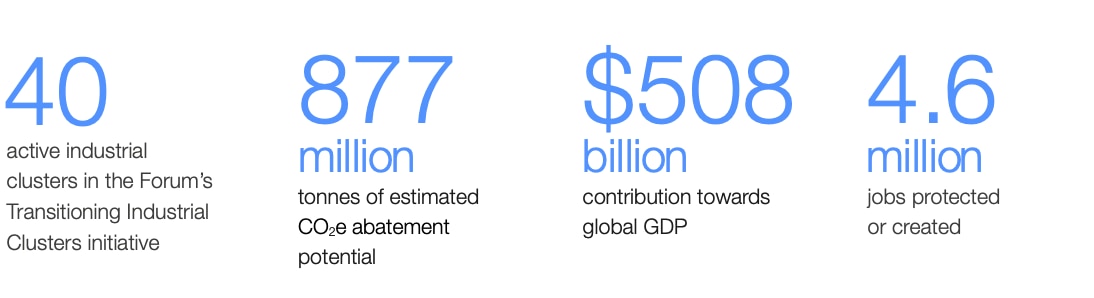
The Transitioning Industrial Clusters initiative aims to improve collaboration and develop a shared vision among co-located companies and public institutions with the goal of driving economic growth, employment and reducing CO2e emissions.
No te pierdas ninguna actualización sobre este tema
Crea una cuenta gratuita y accede a tu colección personalizada de contenidos con nuestras últimas publicaciones y análisis.
Licencia y republicación
Los artículos del Foro Económico Mundial pueden volver a publicarse de acuerdo con la Licencia Pública Internacional Creative Commons Reconocimiento-NoComercial-SinObraDerivada 4.0, y de acuerdo con nuestras condiciones de uso.
Las opiniones expresadas en este artículo son las del autor y no del Foro Económico Mundial.
Mantente al día:
SDG 09: Industria, Innovación e Infraestructura

La Agenda Semanal
Una actualización semanal de los temas más importantes de la agenda global
Más sobre Transición energéticaVer todo

Kate Whiting and Becca Byrne
23 de marzo de 2026