

Transcripción del podcast
This transcript has been generated using speech recognition software and may contain errors. Please check its accuracy against the audio.
Robin Pomeroy: Welcome to Radio Davos, coming to you on day five of the World Economic Forum Annual Meeting 2026.
It's Friday, the 23rd of January. Give us a few minutes and we'll give you the rundown of what's happening in Davos today.
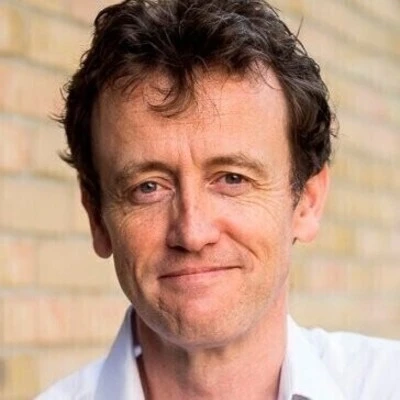
To help us look forward to day five, the last day here in Davos, I'm joined by Anne McElvoy. Hi Anne, how are you?
Anne McElvoy: Hi. Well, it's been quite the week, hasn't it?
Robin Pomeroy: It really has, Anne. Tell us, you're a podcaster, my fifth podcaste of the week. It's been brilliant meeting people doing all this great work. I know that you are executive editor at Politico and co-host of the Politics at Sam and Anne's podcast. Tell us what is that?
Anne McElvoy: So Politics at Sam and Anne's goes out in the UK in the morning. Sam and I, Sam Coates from Sky News and myself, we get up horribly early. And we do a podcast that is out, we hope, if we can nail it, at about 20 to 8 in the morning, just when people are doing their commute or making the coffee or shouting at the kids.
But basically, it gives them a guide to the day in British politics. And I bring in a lot of the international angle. So we've been doing that from here, but we've also done a special longer episode with big interviews called EU Confidential and that goes out to a more European audience. So we have a podcast for Europe and some that would perhaps lead more on the UK and then broaden into Europe.
Robin Pomeroy: Right, but you're a journalist with very much an international outlook though as well.
Anne McElvoy: Yes, I bring the international. I'm not giving up on coming to Davos.
Robin Pomeroy: All right, OK, well, let's look at the fairly light agenda on the final day. It's kind of all over by lunchtime. And then maybe I'll ask you some of your reflections on the week as a whole.
But let's get this out of the way. At 9 o'clock this morning, there's Geopolitical Risks Outlook for 2026, people I've got on here, the chair of the Commission on the National Defence Strategy from the USA, Eswar Prasad, Professor from Cornell University, Wolfgang Ischinger, President of the Munich Security Conference Foundation Council, and Elizabeth Thurbon from the University of New South Wales.
Geopolitical Risk Outlook, the World Economic Forum, produces a report called the Global Risk Report, and that just came out a few days before the start of Davos. I expect, Anne, you've got your own reflection on what the big risks are facing the in terms of geopolitics and probably have been discussed here. It's always an extraordinary time if you're a news journalist, but it is an extraordinary time isn't it?
Anne McElvoy: Yeah, I think geopolitical risk has often been a topic and I know you do this very good report that looks at that and looks at the fissures around the world and where the immediate dangers might lie and those that are a bit more hidden, you know, also perhaps conflicts that are not getting the coverage day-to-day in the main media outlooks.
I think the difference with this Davos, and I don't know if you see it this way as well Robin, it's just felt geopolitics was very much to the fore and geopolitics now is much more about, perhaps, the risk. Opportunity is certainly part of it.
But when you think that this is a World Economic Forum, it's always been about the relationship between business and geopolitics. Well, right now it feels like the risks, the potential downsides, we saw that. I'm sure we'll come onto it, walking up, possibly down the hill on that Greenland lurch by Donald Trump and how Europe and NATO were responding.
To me, it seems like the geopolitics is really now about geo-risk. And if you can sort out that, or at least get that into some sort of, I don't want to say control, that's probably ambitious, but bring it into balance a little bit better. I think that's also what Mark Carney, the Canadian Premier, was suggesting in his speech, then everyone can take a breath.
I think the worry is that one thing comes after another, and that's when unforced errors do occur. Leaders can make them reactions by those who have very good values themselves, but if they're put under immense pressure and asked to decide quickly. Do I support this person, that person? Do I this conflict, do I not do it? I think this is the real risk, is the speed of the cycle.
Robin Pomeroy: And you mentioned economy being at the heart of the World Economic Forum. At 11 o'clock is the Global Economic Outlook with, I'll give you the runners and riders, Ngozi Okonjo-Iweala, head of the World Trade Organisation, Christine Lagarde, president of the European Central Bank, Kristalina Georgieva, the managing director of the International Monetary Fund, and we have Mohammed Al-Jadaan, the minister of finance of Saudi Arabia.
Also, the World Economic Forum produces the Chief Economist Outlook, which also, that comes out three times a year. And the most recent one came out just a few days again before this.
It's so interlinked, isn't it? The uncertainties about the economy, it's all dominated by the uncertainties about, well, not all dominated, maybe. Maybe there are some other elements. I was going to say dominated by geopolitics. Of course, the other big thing here this week has been artificial intelligence, which has been a driver of the economy, of the world economy, in fact.
Have you picked up any interesting ways the wind is blowing on the economy? The global economy?
Anne McElvoy: Two different angles on that.
The list of people, should be a great panel that you're doing on the final day. But, you know, I would have a bit of a challenge if you look at the IMF, certainly the World Trade Organisation. These are two organisations which, geo-risk in this sense, really means what is Donald Trump doing, what's his outlook, and we're definitely seeing that these organisations being somewhat downgraded in his eyes.
And the rise of China, which is also an opposite pole, and also does not really readily align if you like. I just call them the three letter entities. Anything with three letters is under threat in the world today.
Robin Pomeroy: World Economic Forum.
Anne McElvoy: Oops. But you know in some ways maybe I would stand by my three letter acronym because the forum is still clearly very attractive. If you've got Donald Trump doing his major course correction and he's doing it here at the Forum, well clearly it has attracted him even if he has railed about Davos man and woman in the past. If you have Elon Musk coming, ditto.
But I still stand by my statement, really, that i
If you've got that kind of three-letter acronym in the world that came from, you've probably got some challenges. I would say the same about the NHS in the UK. The BBC. See? My rule works. That's what I'm telling you. I'm going to come next year and I'll get a whole half an hour out of, if you got three letters, you're in for a difficult time.
So there it is. I'm sort of joking with you. But I do think this is a fundamental point when you ask about the risks, is that a lot of these more kind of rule-based systems, the institutions that came out of them, have just lost their grip or not seem to apply in the same way or have to reinvent themselves, that's also I think the point that Carney was making.
Robin Pomeroy: Is that a medium-term thing? Do you think 2026 will be the year when you'll see some of those three-letter acronym organisations evolve into something that's ready for the brave new world that we have?
Anne McElvoy: Not really, no, no. I think they're kind of lost. And I think that is something that Donald Trump has been very good at sort of putting that pressure there.
And frankly, some of them, let's say, you should wind up the IMF, I'm not quite that crazy. But I do think there is just a change in the power balance. And when we talk about who holds power, institutions have held power. Perhaps they have not always wanted to be so frontal about saying it. They're part of a democratic compact if we're talking in the West.
But yeah, look at the way I've been coming here a number of years. You look at what the topics are. Yes, everyone is sort of now hoping AI will solve some of these problems, but you probably, if you're going to think about where you're putting your time in investment, you're probably going to be putting time into thinking about the impacts of AI on companies, on workforces, on public services and on governments and how they try to deliver for often for quite dissatisfied populations, then you are about whether something is going to reinvent itself. If those organisations reinvent themselves to deal with this, they'll be relevant. If they don't, they will be talking shops and nothing more. And I do think that's a real danger.
Robin Pomeroy: We'll be hearing from some of the leaders of some of those organisations at 11 o'clock this morning.
At midday, closing remarks from Borge Brende. And that brings this turbulent week to a halt.
I always like to ask people, in fact, we're recording this, full transparency, although it's our morning show, we're recording at about, coming up for four o' clock in the afternoon on the Thursday before Elon Musk's surprise visit. He should be speaking. In about an hour from now. So that's why we've not mentioned him because it hasn't happened yet as we record this. I'm sure it will have lots of news coverage by the time this goes out on Friday morning.
But what I'll be doing on Friday, it's become a bit of a tradition for me, is talking to all the heads of the various centres at the World Economic Forum who are dealing in energy and cyber security and climate and nature and health and economics, I could go on and on, and I ask them basically to say. How is the world a different place now than it was on Monday or Sunday? That's kind of internally how we view things from the World Economic Forum. From you Anne McElvoy, has the world changed after a week in Davos?
Anne McElvoy: Well the world changed really I think when I looked at my phone like a lot of other phones lit up at a dinner at about 7.30, 8 last night when it became clear that Donald Trump had backed off on the Greenland threat or the use of force and that he backed off on the tariffs. Causing a lot of indigestion, causing a lot of podcasts to be re-recorded in terms of their takeaway.
So I think we left the hall yesterday. There was an anxiety in the air. There was a sense that, a great tour de force Trump speech. It was very funny in parts, but it was also quite menacing. And it was very dismissive of Europe. Practically said, Europe's really kind of bad because it's not Donald Trump's America.
It had that sort of fire and fury effect, but we were none the wiser really. The only thing I did notice is he didn't say he was putting tariffs on the 1st of February and you notice if you don't get a date from Donald Trump it probably means he's moving back.
But I wasn't sure, and of course it was only a couple of hours later after the meeting with Mark Rutte that this so-called framework agreement came out. I mean, I think what had happened, to be honest, was he'd already changed his mind, but he didn't want to say so on stage. He couldn't have changed his mind so quickly afterwards.
But you know, we don't know what the framework agreement is. We don't where it leaves the sovereignty claim, which he's still, in speech on your stage, said that he wasn't backing off on the fact that he thought Greenland should too belong to America.
But I think there was a sort of a stay of execution, if you like, you know. We went from people doing kind of shallow, stress breathing to a sort of, oh, yeah, that kind of mood.
So do you think that's, the world has changed? Yes, because the worst option, the most disruptive didn't happen. But then, you know, very good, not long ago, intelligence, head of intelligence for a major European country, let me put it like that, said to me, you the thing is, we're kind of brutalised. We're at this point, if we stop getting beaten up, we're like, oh, that's great. You know, it was a good week. And I do think we need to keep that in perspective.
Those challenges are still there. Donald Trump is still, I think, disruptive to the established global order. He doesn't believe it delivers. And I think we will still see many more of those challenges.
We didn't hear a lot on China, but really, the tariff standoff, for all the use of tariffs against Europe, that's just a hammer to crack a nut. The real use of tariffs that we need to keep our eye on, really slowing down the economy, is China.
Can AI make it up? But then AI bosses here are telling me they're having to spend so much capital. We're going to see a lot of AI companies, I think, in great trouble in the next weeks and months. They cannot raise the capital fast enough. The bigger beasts, the Microsofts, et cetera, probably. They have the agglomeration power to invest in AI.
So to sort of say AI can solve some of the problems, it also disrupts workforces, et cetera. I think it will, but I think along the way, we're going to see a new wave of disruption somewhat similar to the disruptions of the 70s when the Forum was founded.
Robin Pomeroy: Wow, there's a comparison, goodness me. And this could be the year then as well when there's kind of a reckoning with AI in some respects. I mean, people talk about, there is a bubble potentially and that could burst, it might not. And no one would know if anyone knew...
Anne McElvoy: Ken Rogoff thinks he knows because Harvard Economist is a great friend of our podcast. I would speak with him every year.
Robin Pomeroy: What did he say?
Anne McElvoy: And he said he had, he says, you know, because there's a whole joke, which you won't probably be aware of, Robin, about sometimes people say things that Davos that aren't entirely don't turn out to be true. And he's said, look, here's my, he said, I'm going to give you two and you can come back to me next year. He said, either the US stock market will suffer, he didn't say crash, but he said that would have a serious downturn. Or the AI bubble would burst. One of the two, but probably not both.
The AI bubble could burst doing less damage than perhaps some people think. It's the overvaluations, et cetera. Personally, although I'm not an expert in this field, but just taking views where one comes here is to hear lots of people's views and think about them, is it's possible that what we really see then is more consolidation in the AI sector, the spoils going to the bigger players.
But there's no doubt about it, the cost of delivering and the energy cost of delivering the great leap forward in AI, which agentic AI is now capable of, is astronomical. If there is a bubble that bursts, remember we've had dot com bubbles burst and come back again. That is very possible. The AI is here to stay.
I think it's too early, by the way, to talk about reckoning with it. We are just learning with it, we are children in the world of AI and how to deal with it, profit from it, and control it.
Robin Pomeroy: We'd have heard a lot more about AI if it hadn't been for the Greenland thing. I'm sure.
Anne McElvoy: I think you're right about that.
Robin Pomeroy: And in fact, if you're listening to this and you want to find there's many sessions on AI, you can dig into, there have been many conversations about it.
Anne McElvoy: There have been some great sessions on AI, I should say. I think you're right, it's just the news agenda went a bit towards Greenland and other things fell off the agenda a bit, inevitably.
Robin Pomeroy: Well, lucky for listeners to this podcast, they can go to our website and watch those sessions on catch up. Lots of them will be available as podcasts on our Agenda Dialogues thing. That's why we just strip the audio from some of these great conversations and put it out there for you to listen to on a podcast app.
I'm going to plug my podcast Anne, and then I'll let you plug yours. If you've come to Radio Davos just this week and you never heard of it before, it's been going for five years. I do a show every week looking at some of the biggest challenges facing the world and humanity and how we might solve them. Radio Davos. We also have Meet the Leader, conversations with leaders, inspirational. You can find them wherever you get podcasts. And wef.ch/podcasts. Anne McElvoy, where can we get your podcast?
Anne McElvoy: Anywhere good podcasts are sold and traded. And what are they called? Politics at Sam and Anne's. That's a partnership with Politico and Sky News. If you like UK politics, but the transatlantic and the international compact and then if you're thinking, well, actually I want more on Europe and relations with Europe, internal and with the US, then EU Confidential - got a special episode on Davos on the Forum, and that is out this week.
Robin Pomeroy: Okay, we'll look out for that.
Anne McElvoy, thanks very much for joining us on Radio Davos Daily.
Thanks to you for listening to us all this week and like I say, we will be back with a weekly show and we've got some great, great interviews that we've recorded here in Davos.
But for now, from me, Robin Pomeroy from Anne McElvoy, thank you very much for listening and I'll see you soon.
Anne McElvoy: Thanks very much, Robin.
Welcome to Radio Davos coming to you on Day 5 of the World Economic Forum's Annual Meeting 2026.
Anne McElvoy, Executive Editor at POLITICO and co-host of the podcast 'Politics at Sam and Anne’s', joins us to look ahead at the final day and give her assessment of the week, and what might happen next.
Una actualización semanal de los temas más importantes de la agenda global


