


Transcripción del podcast
Lara Abrash, Deloitte: We're at the precipice of some of the things that hold people back, I think we're just about to overcome it.
Linda Lacina, Meet The Leader: Welcome to meet the leader, the podcast where top leaders share how they’re tackling the world’s biggest challenges. In today’s episode we dig into an unsung strategy to bridge gender gaps and drive economic growth: women’s sports.
Subscribe to Meet The Leader on Apple, Spotify and wherever you get your favorite podcasts. And don’t forget to rate and review us. I’m Linda Lacina from the World Economic Forum - and this is Meet the Leader.
Lara Abrash, Deloitte: 85% of women who are in executive positions talk about the lessons they learn from sports as being major drivers to why they're so successful.
Linda Lacina, Meet The Leader: We all know sports is big business but you might not realize that it comprises 2% of global GDP and is poised to more than double by 2030, becoming a 8.8 trillion-dollar market by 2050. That makes it a multiplier for change.
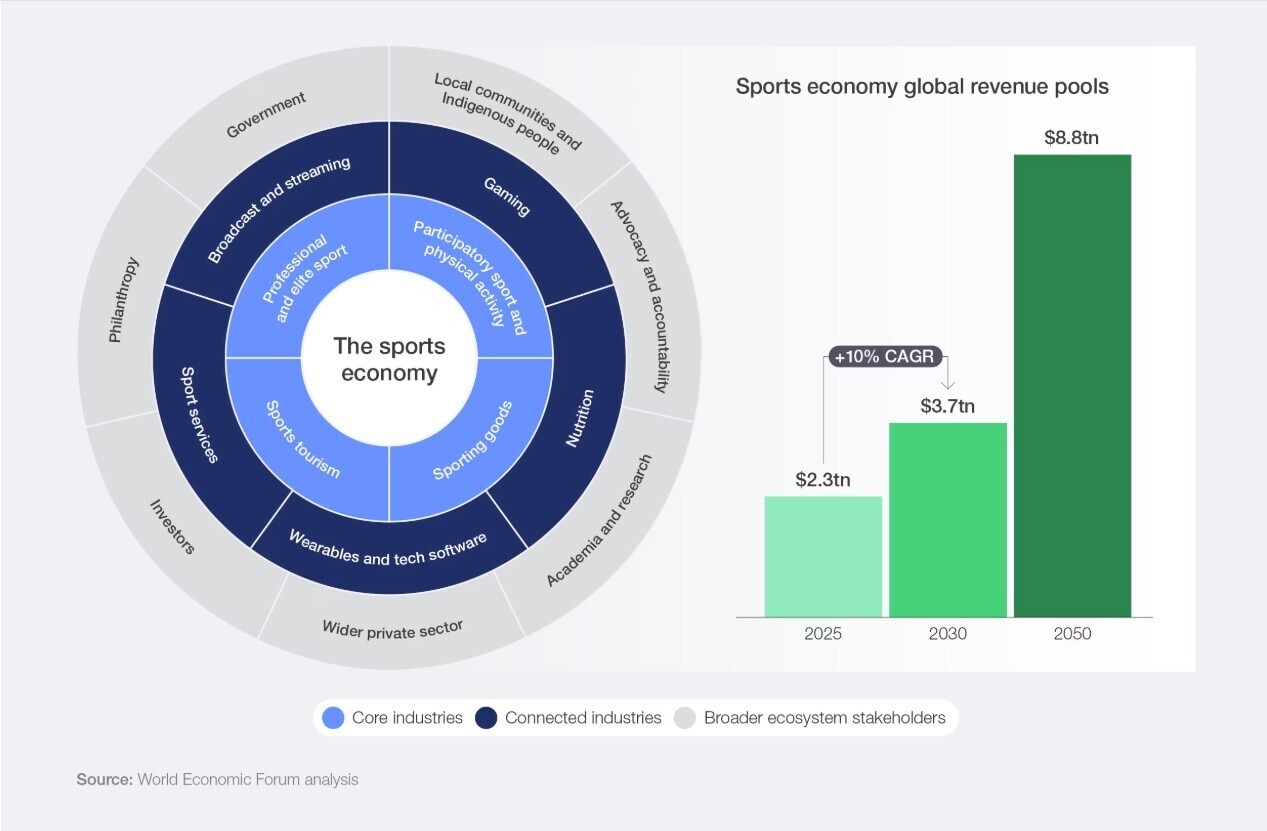
As our Sports for People and Planet report points out - that growth will be an engine for tourism, city development, infrastructure. And it can even tackle health and obesity.
To help drive that growth, we can’t overlook women’s sports. While some projections have that market tripling in the short term, Lara Abrash will remind us that the opportunity is bigger than just a single match or a single game. Support for women’s sports helps develop leadership and cooperation - key for bridging the gender gap and women’s longevity in their careers.
Lara, the chair of Deloitte US, Deloitte being one of the largest professional services firms in the world, will share why investing in women’s sports makes economic sense. But she'll also share personal journey with sport and how it shaped her as a leader and team member -- and what anyone can learn.
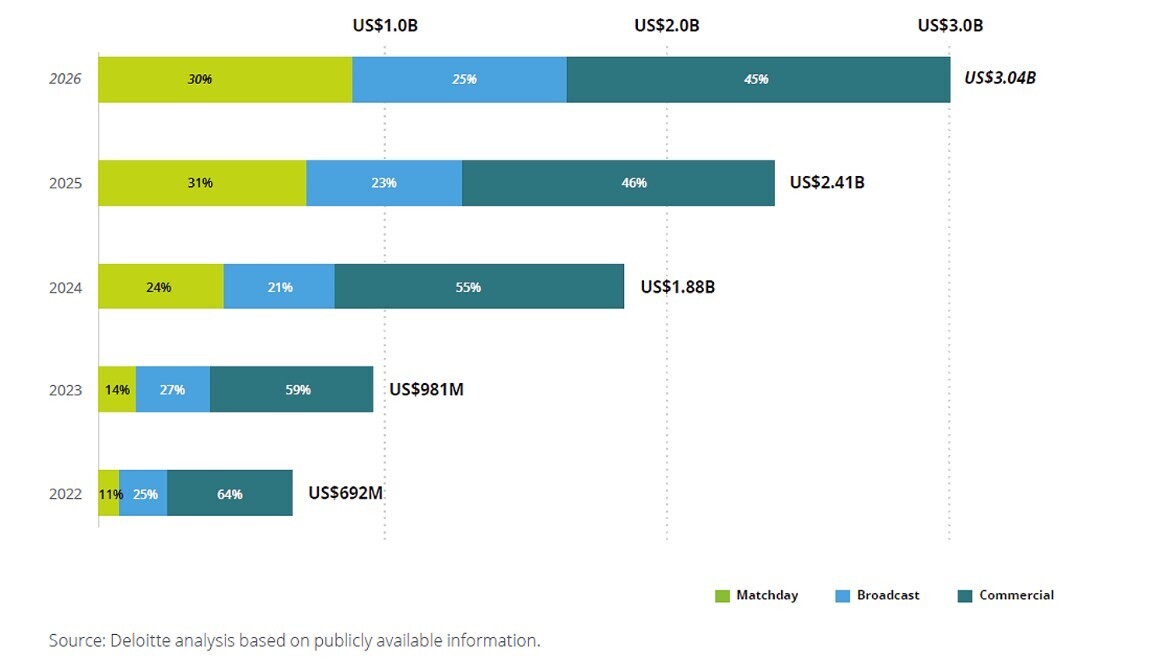
Lara Abrash, Deloitte: Well, we're definitely in a moment when it comes to women's sports. For several years, we've been talking about this emergence of women's sport. But we are now going from nearly $2.5billion of global revenue to, ultimately, over $3 billion in ‘26. And each and every year, we are seeing double-digit growth. And for me, as a business person – I've been doing business for over 30 years – when you see momentum of each year, double-digit growth, we're now scaled into a moment of being able to try to scale this even greater into hopefully a place where we're starting to near what men's sports have looked like, which also took decades and decades to get many of these sports to where they are today.
We're definitely in a moment when it comes to women's sports
”Linda Lacina, Meet The Leader: Now there's still, amazingly, an investment gap. Can you tell us a little bit about that? What is it and why does it exist?
Lara Abrash, Deloitte: Yeah, there's a really big gap when it comes to women's sports. Ultimately, a lot of organizations are not necessarily seeing the ROI in the way they necessarily saw in men's sports, so the investment dollars are not going in in the way that you’ve historically seen in men’s sports. And even though there's huge excitement and interest in women's sports, we're not seeing the dollars necessarily follow through.
We ultimately are seeing the ROI [return on investment] lagging, because ROI does come from how many eyes are on the screen. And when we're now getting displayed at the same level as men's sports, you're not going to see the ROI.
But the reality is we now need to think about ROI differently when it comes to women's sports, because the interest is incredibly high. The merchandising opportunities are incredibly high, The engagement with the leaders, the athletes themselves, very different from men's sports. There's a huge interest in women as influencers, as you know icons, people that go beyond the field. They want to hear about their stories, the engagement in social media, so we have to think about this ROI greater, but ultimately there's a huge opportunity, huge opportunity, for return on investment, to get in now to be part of the future. It's not just the right thing to do, it truly is an investment opportunity.
Linda Lacina, Meet The Leader: There were some statistics I found. Women's sports get just 10% of the sponsorship dollars, 15% of the media coverage, of course just a fraction of things like broadcast right fees and things like that. What is holding people back? What are they saying anyway?
Lara Abrash, Deloitte: Well, they're saying that, again, that they're not necessarily seeing the same type of return on investment that they see. But it ultimately becomes this vicious cycle. If you don't display the sports on the TV to get the advertising dollars, to get the viewership buys, you're not going to necessarily see the ROI come in that way. So we have to start putting in more money to get them displayed. Ultimately, that's what's going to lead to the path.
It requires people seeing this interest, and we're really there. We are truly there right now, that investment should be going in, and we'll start to see us get over that hump. So it's about getting viewership rates and people seeing the broader KPIs that come from women's sports.
Linda Lacina, Meet The Leader: As you've been digging into this topic, what has surprised you? Where have you been like, ‘Oh gosh’, what's taking you aback?’
Lara Abrash, Deloitte: Well, what surprises me most about the data I'm seeing is, ultimately, I think about women's sports in three life cycle elements. There's the entrance into the sport, so girls coming in, and then staying in sport -- becoming professionals, and ultimately really versioning the opportunities, and then leaving sport into leadership.
When we talk about the entry into sport, one of the things that surprised me is how hard it is for girls to want to stay in women's sports. Forty-five per cent of girls do not stay in sport. They leave because of body confidence issues. And when you look at that data and you think about girls coming from economic households that are lower, it's six times even more. The opportunities for girls to participate in sport is 1.3 million times fewer than men's sports.
So this ability for girls to just get started and stay is so much lower and there's so many barriers. There's the physical views about it, the mental views about it, the cultural norms about girls playing sports, and if they're not going to even get into it and stay with it, then the opportunities to be a professional and the opportunities to take sport into life just becomes even harder.
Linda Lacina, Meet The Leader: I read Deloitte had done its own survey that found a connection between women leaders, and sort of a background in sports. So it prepares them for teamwork, but also to sort of drive things. What do you think about that?
Lara Abrash, Deloitte: Of course, we have this saying at the firm - girls who play become women who lead. And we have data behind it. Our survey has told us that 85% of women who are in executive positions talk about the lessons they learn from sports as being major drivers to why they're so successful.
Over 90% of them would say that they're at an even higher level because of sport. And I myself have had that benefit. And I see that with our clients, our peers. It's in government. It's in business. It's almost every facet of life. The more a girl can play a sport, the more she's going to gain some of these lessons that will help her later in life.
Linda Lacina, Meet The Leader: How about just keeping girls in sports? We can start there. What's needed to fix that?
Lara Abrash, Deloitte: So many things. So for a girl who wants to be staying in sports, it's the cultural norms, it is the role modelling. One really interesting data point is over the last 40 years, 50 years, we've actually seen a decline in the number of women coaches. So back in 1972, we had a huge number of women coaching. Now only 40% of coaches are women. And when you think about the confidence to actually want to be a player, you want to look up and look at role models that look like you, that make you feel more comfortable.
So the lack of women's coaching is one element. The other element… I talked earlier about the cultural norms. We need to encourage these girls to want to stay. We need to encourage them to understand that it's okay for women to have a different body size to be successful in sport, but these body image things are starting to be a reason to hold them back. So it's the cultural norms, it's the coaching, the role modelling, that will start to settle, hopefully, girls wanting to enter and stay.
Linda Lacina, Meet The Leader: And what about elsewhere within professional sports? Are there certain strategic investments that we need to be making? Maybe either to the pipeline or also to maybe the structure of some of these organizations, these affiliate organizations and things like that. What strategic investment should we be thinking about first?
Lara Abrash, Deloitte: We need to invest into the leagues. We need to be investing into the teams so that they can start to pay their athletes at the right levels. A really interesting data point we found that over three-quarters of the women who play sports professionally make less than $50,000 US. I mean, that is not going to allow somebody to raise a family, to live their life.
So ultimately we have to invest into these organizations so that they can pay the athletes. The more they do that, there’ll be more interest in girls actually wanting to be in sport and stay in sport, which ultimately, when they leave sport, will help society because we'll have more women leaders.
Linda Lacina, Meet The Leader: What is needed, maybe, to change the mindset? How does that work?
Lara Abrash, Deloitte: Well, we need to change the mindset of investing. You're talking about this. So to change a mindset of who wants to invest into it, and as I said earlier, it's really having them understand the real return that we'll get. The ability to get more viewership, to get women on TV playing sports will create a greater ROI. So we need to be able to change the awareness. But ultimately, there are other KPIs and just viewership as a way to understand how women's sports creates an ROI.
The ability to get more viewership, to get women on TV playing sports will create a greater ROI
”As I said earlier, you actually have an ability to have deeper, deeper, deeper engagement with the athletes, which creates outsized merchandising opportunities. So when you look at the whole ecosystem of what a women's sport brings, it brings much greater ROI than just what you would naturally see for TV ads. So we have to invest in the leagues, we have to invest into getting more opportunities for media, and more opportunities for viewership.
Linda Lacina, Meet The Leader: Even the NFL had to build to where it is. We've seen this growth with other sports. We've seen it with soccer. Soccer was something that maybe wasn't being watched 20, 30 years ago like it is today. Why do people struggle sometimes to see the potential of something that hasn't existed yet?
Lara Abrash, Deloitte: Well, there's a lot of reasons we struggle. One reason is ROI, there's limited capital. So when organizations are thinking about where to put their dollars down, they can invest back in their employees, they can invest in technology, AI. This idea of investing in branding and investing into the opportunities to get an ROI through women's sports is something different. And there's a natural cultural norm to have this hesitation. Is this going to generate it?
And it requires, quite frankly, pioneers. You mentioned women's soccer. Huge pioneers to actually get the championship game on at night. It was a herculean effort to do that, but ultimately the response by the viewers was overwhelming. Women's soccer actually gets greater viewership than men's soccer does, but ultimately was not getting the same opportunity. So it takes real pioneers.
Billie Jean King did it for tennis. She actually continues to do it today for a lot of these other teams. Now you're starting to see investors invest in new sports. We now have a women's hockey league. We have women's baseball. You're starting to see this expansion. I actually think we're at the precipice of some of the things that hold people back, I think we're just about to overcome it.
Linda Lacina, Meet The Leader: Is there a change story that you can kind of point to that really shows that before and after, where there was an investment and it really paid off and it showed kind of the direction we could be going in?
Lara Abrash, Deloitte: Well, if I think about where we are in 2025 going into 2026, one of the things I think about is I took the Olympics as a start. The Olympics [2025 Summer Olympics], for the first time ever, had gender parity, where you had the same number of women athletes as men athletes. And for the time, we had a women's rugby story.
And because of some of the athletes themselves, the excitement and the interest now in women's rugby has changed significantly just from the Olympics having parity to just an amazing year of women's rugby. And now there's an interest in that sport outside of the Olympics in a much greater way.
That's an example of that dynamic of the athletes themselves and the attention they can bring. They're influencers, they're on social media, they are doing podcasts, and the interest in their stories is so much greater as is their interest in the sport.
Linda Lacina, Meet The Leader: If we get this right, if we get women's sports investment right, what does the world look like in, say, 20 years? What could we expect to see?
Lara Abrash, Deloitte: If we get women's sports right, the investment in it right, I think there's two or three things that will happen. One, I believe, to start, because this is the most important thing, that actually it will generate real business and money for society, for business leaders. This is not something we're doing because it's a nice thing to do or the right thing to do. We're actually doing it because it actually will create great outsized ROI. That's one.
Two, I believe we will have even greater women leaders in the future, because the more women we have in sport, exiting sport into executive roles, business roles, you name it, we're going to have more.
And the thing that excites me the most is the girls themselves will look up. And they'll say, they did it.
So I think in 20, 30 years, it won't be a question about body image, and do I have a woman coach? I just want to play, and I think we'll have a huge ROI. And then ultimately, leaders won't be coming out in droves because they played sports.
We'll have not just a greater number of women leaders, but whether they're sitting in CEO seats, board chair seats, senior roles in the government, there'll be more women that can be positioned to take on these roles. And if they leverage the skills they build from playing sports for all those years, they're going to be better positioned to be successful in those roles.
Linda Lacina, Meet The Leader: I want to talk a little bit about sort of what drives you and inspires you and maybe the role that sports has played in your life. You were the only girl on your baseball team as a child?
Lara Abrash, Deloitte: When I started to play sports, I have three older brothers, so my mom, of course, as the fourth was like, ‘Okay, you've got to go play sports also.’ And also there was no softball team in my town. There was no girls' baseball team.
So when I grew up, the only way to play sport, to play baseball, was to actually be on the boys' baseball teams. So yeah, I was the only girl on the boys' baseball team. And that's how I started, and that's all I know. I joked that I played the position left out, but ultimately it was a great experience. And that was normal back then. Today that's not as normal, but back then that's just the way it was.
Linda Lacina, Meet The Leader: How does that prepare you?
Lara Abrash, Deloitte: Yes, Sports has been huge for me. I could talk all day about the things I learned. I'll pick a few things. One, I often talk about grit. Grit is the part of your elbow that's rough, that you get over time from falling and hitting things. That's what grit is and grit ultimately is the thing that shows up when things aren't going well and powers you through the really tough moments.
And if you played sports, being on a losing team in those hard days of practice when things don't go right or when you show up and the team doesn't pull it all together, you lose, and you're just building that grit on you and that's something that I benefited from. I played baseball, I played tennis, I played basketball, a lot of different sports and ultimately all those experiences helped me in ways that I sometimes don't even think about.
As a leader in business, you're not necessarily there because you're the best person at whatever your company does. You're the best person who can tap into what every person can bring, the best version of themselves.
”Another area that sports has been great for me has been the knowledge that it's okay to not be the best person on the team. Ultimately it's about bringing the team together. And as a leader in business, you're not necessarily there because you're the best person at whatever your company does. You're the best person who can tap into what every person can bring, the best version of themselves. And that's what a team is. That's what whatever sports team you play on, it's about bringing that person in to play their position in a certain way and to contribute to the team.
And there's so many other things, communication, teamwork, and the like. All of that comes and it builds a girl's confidence. And when confidence gets built, you don't have to have someone in the back of your head telling you how great you are. You start to realize, ‘I can do this’. And when you get to those hard days at work, you have that confidence with you.
Linda Lacina, Meet The Leader: There's a thing when you're working together on the field, where you learn that you can solve problems together. We don't need anyone to be a superwoman. How do sports help women sort of overcome the superwoman fallacy?
Lara Abrash, Deloitte: Yeah, so as you probably know for years, for women in business, it's been this idea that you have to be the superwoman. You have to be the person who can do everything, and quite frankly, you've had a lot of people fearing that women will go cry if they don't get what they want at work. And so they have to put on this veneer that they have all the answers.
And what sports teaches everybody is it ultimately does take a team. It's a mosaic. It's people of different colours and shapes and sizes coming together to solve an issue. And it's helped women realize that they don't have to declare that they know everything. It actually does, in fact, take a village.
What sports teaches everybody is it ultimately does take a team
”And so the woman who could actually bring the team together, and I would argue that's actually one of the superpowers that many women have, is the ability to nurture and engage others to figure out, ‘How do I get the best out of this person on this particular day, in this particular moment?’ That's what women do. And when they start to realize that that is the power that they can unleash, it's not about them being the superwoman, but ultimately them leading.
I have another saying which is: "Managers manage outcomes, leaders lead people." And that's ultimately what sports teaches you to do. It teaches you to lead people, being a teammate to someone and helping them be their best version and being selfless. Giving them the ball, having them take the shot and kick the goal. That's ultimately what leaders end up doing. They are not the best person in the organization. They're the person who can untap everybody around them.
Linda Lacina, Meet The Leader: Is there a lesson, maybe from a coach or maybe from sports in general, that shaped you?
Lara Abrash, Deloitte: Yeah, probably one of the best lessons I ever got from a coach was there's never enough practice. You cannot know what life is going to put in front of you. I used to have a coach who would take me out, Coach Catalano, he would take me out after school and whenever all the girls left the field we would continue - I played centre field at that time -- and we would just continue to flag fly balls.
And then in a game, I found myself doing something that we had covered that we may not have gotten to. It was like this idea that practice does in fact make perfection. And so you are constantly pushing yourself. This coach told me, when you actually get to a point that you think you're trying to be perfect, you haven't actually pushed yourself enough. So this idea of practice does make perfection is something this coach taught me and he made me live it. And to this day, I try to practice things inside and outside of work – just for that moment when it may come up.
When you actually get to a point that you think you're trying to be perfect, you haven't actually pushed yourself enough.
”Linda Lacina, Meet The Leader: Was there maybe a moment when you were playing sports that maybe helps you even today, either as a leader or even as a teammate? Is there something that's like, gosh, you still use that now?
Lara Abrash, Deloitte: Well, definitely when I was in sports, I was the person who tried to cheer everybody up. I play on a team today. I actually play on an over-25 women's softball team. I joke it's way over 25. And on that team, I'm the manager, despite my big job at work, because I'm the person that really does try to encourage and support and excite everybody around us.
And I think for me, it started to make me realize that, one, I had a natural talent in getting people around me to want to perform and to push themselves and it ultimately taught me that I was more valuable doing that than being the centre fielder.
And that's what I try to bring to work today, that me being the best accountant or consultant is not why I'm here. I'm ultimately here because I can get the people around me excited and maybe to push themselves in ways that they didn't think. And that ultimately really did come from the softball field and still does.
Linda Lacina, Meet The Leader: Are there things that we can learn from athletes about effective teaming, especially maybe women who didn't have the chance to play sports? What are questions they can ask, things they should look for to be even better at teaming?
Lara Abrash, Deloitte: Yeah, I think from a teaming perspective, women really can help each other. I think we're a superpower when we come together. I do find in business, sometimes women are, again, thinking they have to be the person who knows everything, show no vulnerability.
And ultimately, I'm seeing today women who show more vulnerability and are more open to helping each other and being helped and being open that they need help, they start to create better teams around them.
And I think that's something that if you hadn't played sports, you're going to have to realize through experience that it is in fact helping you. But it's not a natural thing. I still find that there is a little bit of competition among women. And it really is a village. When the team succeeds, the person succeeds.
Linda Lacina, Meet The Leader: Is there a book you recommend?
Lara Abrash, Deloitte: Oh, probably All In by Billie Jean King. I think she's amazing.
Linda Lacina, Meet The Leader: And how did it change you?
Lara Abrash, Deloitte: Well, she changes me because she just is so inspiring as an athlete and as a leader. She makes me want to rise to the biggest moment and realize that I have an ability to pay it forward, and give back, and you have to in fact be "all in." You have to give everything to do it and incrementalism is only going to get you so far. So she ultimately has pushed me to be more about giving all of me and not a piece of me. And if I give all of me, bigger things can happen.
Linda Lacina, Meet The Leader: And your last question, what should leaders be prioritizing in 2026?
Lara Abrash, Deloitte: I think leaders should be thinking about, particularly in women's sports, that this is the time right now to find opportunities to invest into the sport. Go back to our organizations and look at our marketing dollars, our social purpose dollars that we're spending, and look at opportunities to get women into investing into sports.
I think leaders should be thinking about, particularly in women's sports, that this is the time right now to find opportunities to invest into the sport
”And then look at your own organization and start to say, ‘Where are my next generation of women leaders? And am I tapping into the athletes in my organization and the skills that they've learned, and how do I start to harness that?’
So, I think there's great opportunity to be the engine to invest right now into women's sports, to engage into it, and then ultimately to harness what is inside your own organization relative to women's leadership.
Linda Lacina, Meet The Leader: That was Lara Abrash. Thanks so much to her and thanks so much to you, for listening.
If there's someone in your life looking to learn more about teaming and cooperation, send them this episode.
And to listen to more podcasts, including my colleague’s podcast Radio Davos, go to wef.ch/podcasts.
To find our recent Sports for People and Planet report, go to the show notes of this episode - we’ll make sure to have a link.
Find a transcript of this episode - as well as transcripts from my colleague’s podcasts Radio Davos at wef.ch/Podcasts.
This episode of meet the leader was produced and presented by me with Jere Johannson and Taz Kelleher as editor, Juan Toran as studio engineer in Davos and Gareth Nolan driving studio production.
That's it for now. I'm Linda Lacina from the World Economic Forum. Have a great day.
How can we fix leadership pipelines? Invest in women’s sports. Data shows that investment in women’s sports creates a powerful yet under-appreciated talent pipeline, building future leaders, driving high-performing teams and helping to close the gender gap. But girls leave sports too early and elite women's sports faces chronic under investment. Deloitte US Chair Lara Abrash shares insights from the firm’s research on women’s sports – both the billion-dollar economic opportunity it represents, the challenges the sector faces, and the unsung way sports strengthens the leadership talent pipeline.
Abrash, active in a range of sports since her youth, will also break down the leadership skills, mindsets, and team dynamics sports uniquely cultivates. She’ll share the personal experiences that shaped how she leads and the way she approaches talent and capability. Her personal lessons learned can help anyone understand what’s needed to develop future leaders, improve team performance and build talent pipelines that last.
Key Insights:

Una actualización semanal de los temas más importantes de la agenda global

Wanjuhi Njoroge
23 de marzo de 2026


