
In today’s fast-moving business world, leaders at all levels need to keep up with the rapid pace of change. But does being quick off the mark make you more likely to be seen as a great leader?
New research by Jack Zenger and Joseph Folkman, CEO and President of leadership development consultancy Zenger/Folkman, finds that there is a strong link between speed and perceived leadership effectiveness.
Writing in the Harvard Business Review, Zenger and Folkman describe how they analyzed 360 feedback evaluations on more than 50,000 leaders to assess the impact of speed on their colleagues’ impressions of each executive’s overall leadership effectiveness.
They created a “speed index” that measured speed in three ways: how well a leader can spot problems or trends early, can respond to problems quickly, and can swiftly make needed changes.
They then focused on the exceptional leaders in the pool (those rated in the top 10% for leadership effectiveness by their colleagues) to see how high scores on the speed index were linked to overall leadership effectiveness ratings.
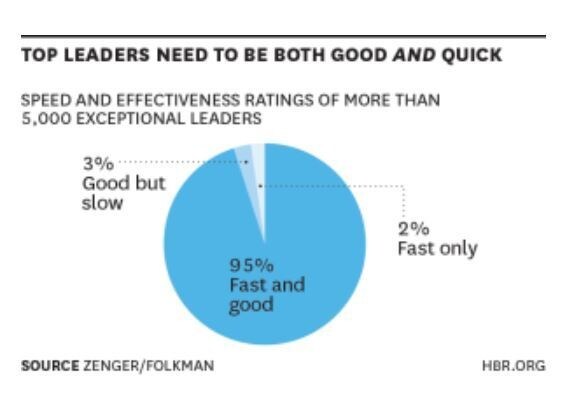
Zenger and Folkman found that of these 5,711 top leaders, 2% were judged particularly fast but not exceptionally effective (about 114 of them); 3% (some 170) were seen as highly effective (that is, people trusted them to do the right thing) but not particularly fast. And 95% (more than 5,400 of them) were perceived to be both particularly effective and particularly quick.
“Being good is only marginally better than being quick,” they write. “But the fact is both are necessary, and neither alone is sufficient, to be perceived as an exceptional leader today.”
What makes a leader both fast and good?
Zenger and Folkman used 360-degree feedback data from more than 700,000 colleagues to identify what sets fast and effective leaders apart from those who don’t move quickly enough and those who race ahead and then trip up.
In the HBR article, they reveal the top five factors, listed in descending order:
1. People who work with them trust their ability to use good judgment and make effective decisions. Without trust, colleagues resist moving fast (or at all). Experienced leaders earn trust through a track record of success built through strong positive relationships and demonstrated expertise.
2. They make their vision and strategy absolutely clear to their colleagues. When people can see the context for action, they can more quickly understand and carry out their part in an enterprise.
3. They demonstrate personal courage. Acting with speed often feels risky. The person looking to avoid added personal exposure will be inclined to move slowly. In general, people are more comfortable working at a steady pace. It takes a great deal of courage to move faster and ask others to move fast with you.
4. They assemble world-class expertise and knowledge. When leaders lack expertise they have to stop and do their homework. Lacking knowledge leaves you in uncharted waters where your inclination is to be slow and careful. Conversely, having or accessing world-class expertise allows you to work faster and make better decisions.
5. They set stretch goals. Easy goals allow people time to reach them in a leisurely way. Stretch goals reinforce the need for speed. They encourage people to get on with their work rather than ponder.
(If you would like to evaluate your own pace and see how you compare, take Zenger and Folkman’s Pace Assessment.)