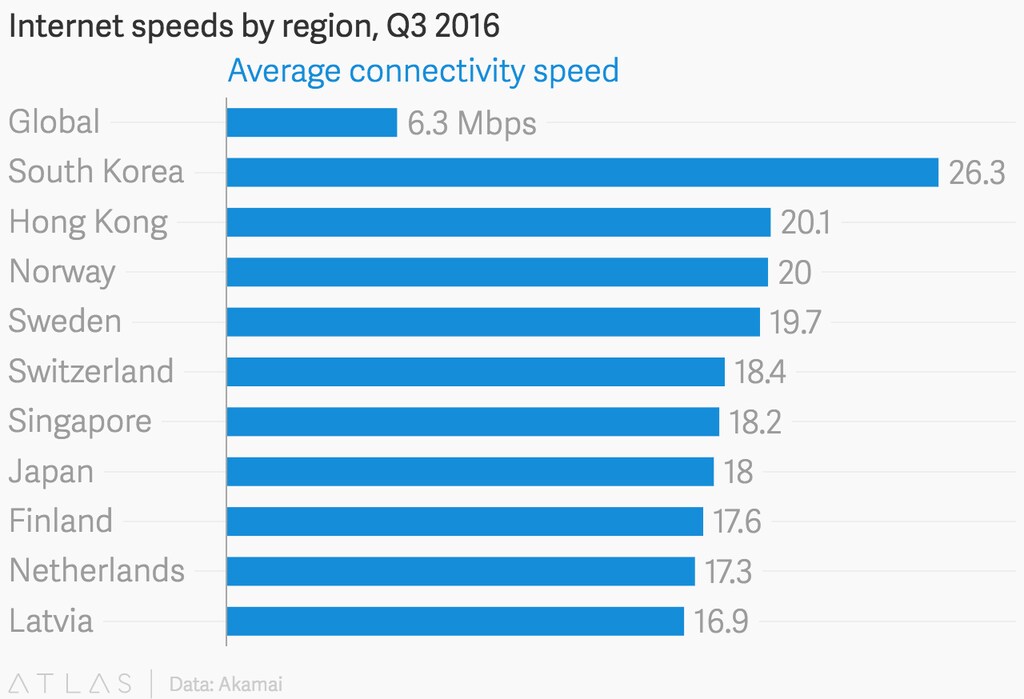
South Korea tops the charts when it comes to measuring the world’s fastest internet connectivity speeds. At 26.3 megabits per second, it was the only country above the 25 Mbps threshold in the third quarter of 2016, according to a new report (pdf) published by US-based cloud services provider Akamai.
South Korea’s hyper-connectivity is no surprise: It is the result of nearly 20 years of labor.
In the 1990s, the South Korean government made a big push toward the broadband industry. It liberalized its telecommunications sector, built a robust national infrastructure for high-speed internet, and introduced regulations to keep the broadband market competitive. The government encouraged citizens to get computers and use high-speed internet connections by subsidizing the cost for low-income people and others not connected at the time.
Between 1996 and 2001, there was a six-fold rise in Korean internet hosts. And South Korea is the world leader in broadband adoption with a rate of 78%—”10 percentage points higher than second place Japan,” the report said.
A high population density works in Korea’s favor. Over 80% of the country’s citizens live in urban areas—setting up fast connections over short distances is more efficient. Places like Hong Kong and Singapore also place highly when it comes to top internet speeds in the world, largely because they have a 100% urban population. At a 5.3% increase, Singapore saw the greatest jump in connection speeds from the quarter prior, according to the Akamai report. (The US, on the other hand, suffers in these metrics because of its suburban sprawl.)
The global average connection speed rose 2.3% from Q2 to Q3 2016, landing at 6.3 Mbps.
Despite Latvia, South Korea, and Norway posting quarterly decreases of 3.5%, 2.5%, and 0.2% respectively, they managed to retain a spot in the top ten. Iceland didn’t have the same luck: its 5.4% drop in speed from Q2 to Q3 caused it to slip down from the 10th spot to the 14th.