
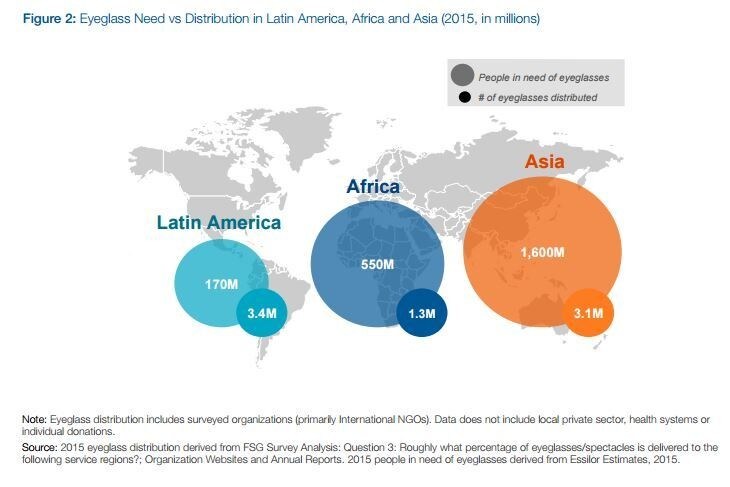
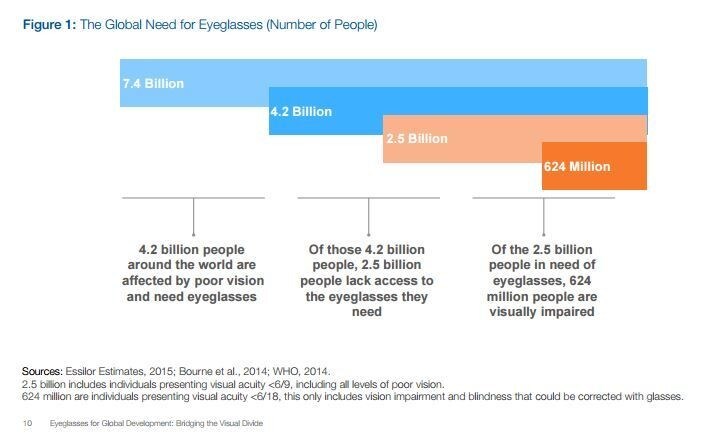
For many people, wearing glasses can mean the difference between working and being unemployed, or learning to read and being illiterate. Yet today there are 2.5 billion people – 80% of whom are in the developing world – living with poor vision unnecessarily because they do not have corrective eyewear. It's a situation that is not only robbing them of their educations and livelihoods, it’s also costing the global economy.
The world economy falls short of $227 billion every year from lost productivity among adults who need glasses, according to a joint report from the World Economic Forum, the Schwab Foundation for Social Entrepreneurship and EYElliance.
Providing affordable access to reading glasses alone would boost productivity by up to 34%, and would also help bring down levels of illiteracy, which costs the global economy $1.19 trillion each year. In fact, almost three-quarters (74%) of illiterate adults failed one or more parts of a vision screening, the report found.
Without glasses, children with poor eyesight are at a big disadvantage in school because 80% of all learning occurs through vision. Correcting their vision with properly prescribed glasses would lead to better test scores and have a bigger impact on academic performance than any other health intervention, the report says.
For adults with poor eyesight, having glasses could enable them to get jobs or remain in the workforce for a longer period of time and improve people’s chances of overcoming illiteracy. There are also other less obvious benefits of correcting people’s vision, such as road safety and increased participation in the digital economy.
Despite the huge social and economic benefits, just $37 million, or 2 cents per person affected, was spent on solving this problem in 2015 – less than 1% of the resources allocated to other global health and development problems, such as river blindness, malaria and access to clean water and energy.
The report argues that the problem can be tackled through political will, investment and by bringing the private sector on board. And it calls on governments and businesses to work together with development organizations to make access to affordable glasses a global development priority.
“Solving this problem is within society’s grasp, but it needs to seize the opportunity to harness market forces for accomplishing the task,” the report says.
“Although eyeglasses have existed for hundreds of years, scaleable distribution models have now emerged and new technologies are being tested to accelerate access.”
Have you read?
The biggest curable disease that no one is talking about
How to cure blindness around the world