
It is no secret that the US isn’t much of a global leader when it comes togender parity in the workplace.
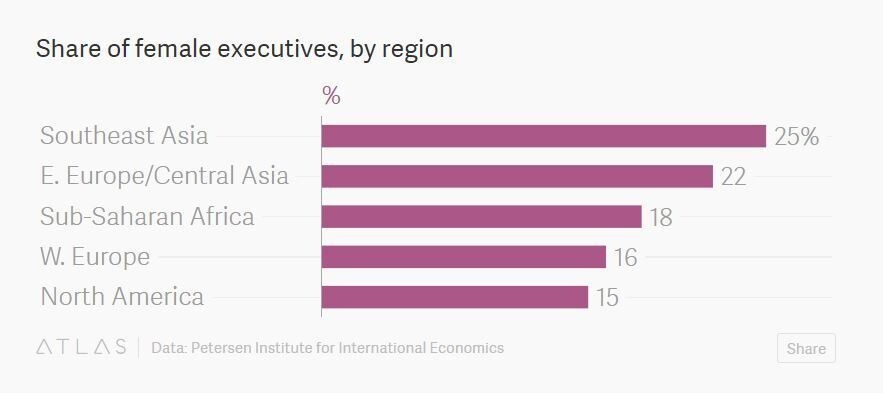
A recent report looking at the impact of female leadership on corporate profits reveals just how far it lags other regions. For example, southeast Asia and eastern Europe are way ahead of North America when it comes to the share of female executives at local companies:
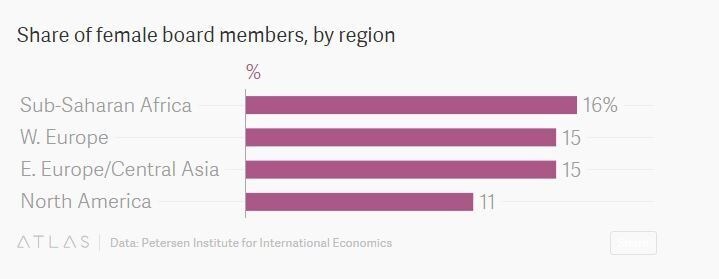
Things don’t look much better for North America when you consider women’s representation on boards of directors:
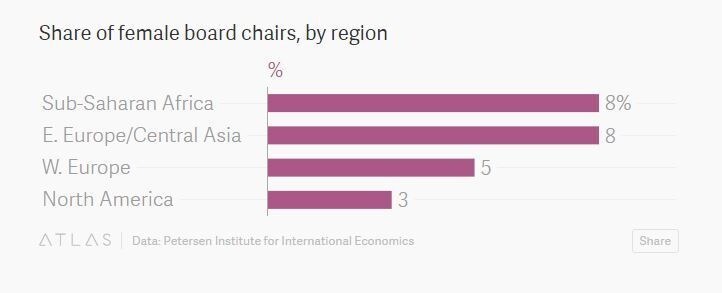
As far as women chairing those boards, sub-Saharan Africa is top of the rankings, with North America trailing far behind:
And finally, North America won’t be winning any gold stars when it comes to female CEOs:
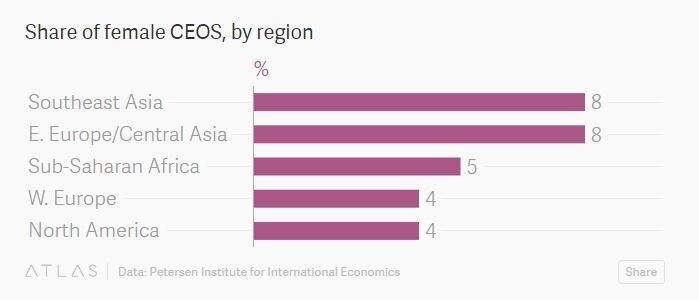
These numbers come from a Peterson Institute for International Economics analysis of 21,980 publicly traded companies in 91 countries.
One of the report’s surprising conclusions is that gender-based quotas—often viewed in the West as patronizing and perhaps even counter-productive—have no impact on profitability but may help bolster the pipeline for more women to reach the executive ranks. A recent report by Catalyst came to the same conclusion. Norway, France, Kenya, and Malaysia are among the countries with quotas, according to the report. The US? Not so much.