Welcome to your weekly curated list of some of this week’s most interesting stories on economic growth and social inclusion.
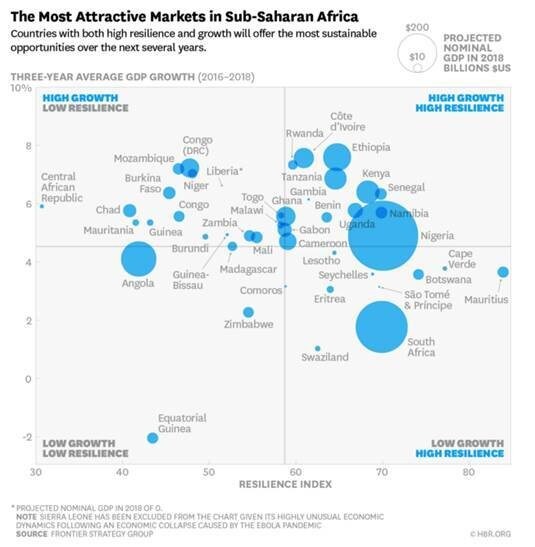
1. Facts and figures. Frontier Strategy Group, an emerging markets research firm has assessed the resilience and growth potential of sub-Saharan economies. (Harvard Business Review)
2. The People’s Bank of China is counteracting the country’s large capital outflows by spending reserves – close to 100 billion dollars a month. More sustainable solutions include introducing capital controls or floating the Yuan. (Bloomberg View)
3. The Dutch Minister for Foreign Trade and Development Cooperation, Lilianne Ploumen, describes her plan to contribute to more inclusive growth. (The Guardian)
4. While Minister Ploumen advocates a greater use of taxes, other policies are possible too. Watch a Davos debate pitching redistribution against promoting equality of opportunity, featuring Angel Gurría, Joseph Stiglitz, Ricardo Hausmann, Crystia Freeland and Richard Samans. (World Economic Forum)
5. Amid violence in the streets, a slowing Chinese economy and a high volume of capital outflows, Hong Kong stocks plunged. (Blooomberg)
6. Yet consumption seems to be a bright spot in the slow-down of the world’s second largest economy. (The Wall Street Journal)
7. When can investments have a financial and social return? Innovative financing – think development impact bonds – and public-private collaboration are important pieces of the puzzle. (World Economic Forum)
8. Joseph Stiglitz and Hamid Rashid argue that the flood of liquidity issued by central banks after 2008 has disproportionately flown into financial markets and has not gone into the real economy. (Project Syndicate)