A new report highlights the fact that in many countries, the overwhelming majority of young people still live with their parents.
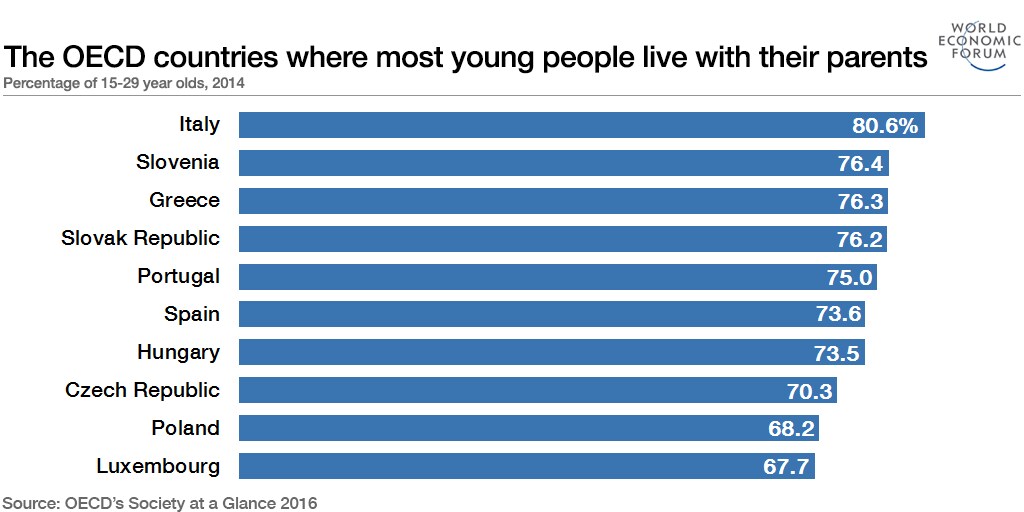
The OECD report, Society at a Glance 2016, also shows that there is a great deal of variation in how long young people carry on living at home.
In Italy 80.6% of 15-29 year olds live at home. That's closely followed by Slovenia, where 76.4% live at home, and Greece and the Slovak Republic where 76.3% and 76.2% respectively live at home.
In Canada and the Nordic countries it is a different story. Young people there are far more likely to be living in their own place. In Canada, 30.9% of young people still live with their parents, in Denmark it's 34.3% and in Sweden it's 35.1%, Finland and Norway have similar percentages at 36.9% and 37.8% respectively.
Why are more young people living with their parents?
The global financial crisis hit young people the hardest. In 2015, 15% of youth in the OECD – about 40 million young people – were not in employment, education or training, according to the report. There are many benefits of living with parents, many daily expenses such as housing and food are taken care of, for example.
France saw the biggest increase in young people living at home in the years between 2007 and 2014, at 12.5%. Hungary saw an 8.9% increase, Italy a 5.6% increase. There was a 0.7% increase overall in the OECD.
The report also suggests that young people have been living at home longer, and getting married later, because of the recession. At the start of the 1990s men got married at an average age of 27 and women got married at an average age of 25. In 2014 those ages were 34 for men and 31 for women.
These findings echo that of the Pew Research Centre, which has found that more young adults in the US are living with their parents than at any time since 1940. It also found that men are more likely than young women to live in their parents’ home: 54.4% versus 41.7%.