Ultrasound technology could offer new hope to Alzheimer’s patients, an Australian research team has found.
The Queensland Brain Institute in Australia has developed the highly promising treatment, which works by clearing the brain of the neurotoxic amyloid plaques responsible for the loss of memory and other cognitive functions associated with Alzheimer’s.
"The word ‘breakthrough’ is often misused, but in this case I think this really does fundamentally change our understanding of how to treat this disease, and I foresee a great future for this approach," said one of the project’s researchers, Jürgen Götz.
What is Alzheimer’s?
Alzheimer’s disease is the most commonly occurring form of dementia, which refers to a set of symptoms including memory loss, and difficulty with thinking, language or problem-solving.
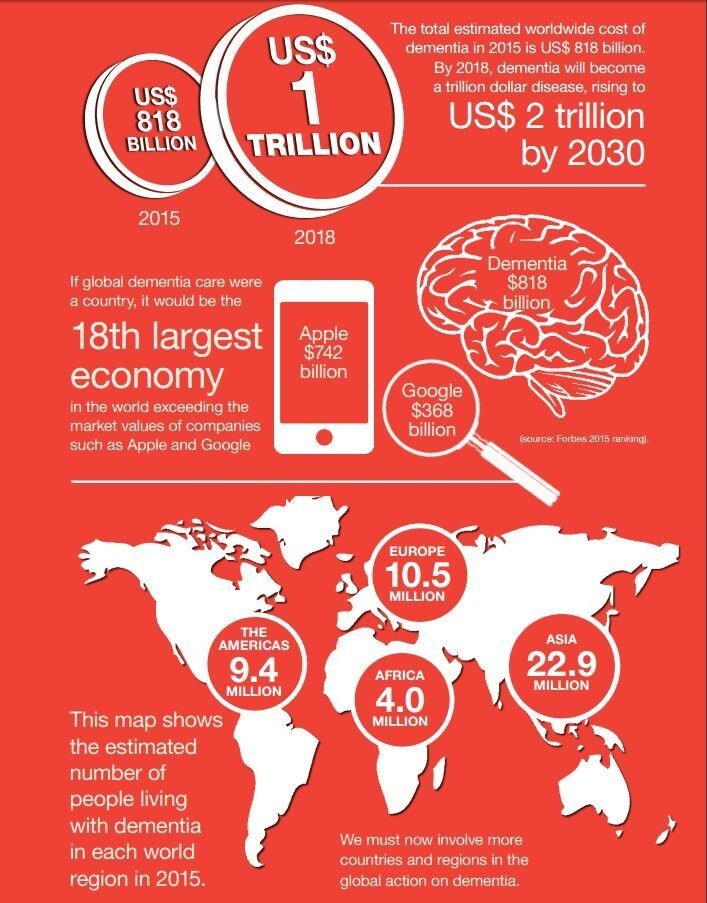
Source: World Alzheimers Report 2015
Named after Dr Alois Alzheimer, it is caused by the build-up of proteins into ‘plaques’ and ‘tangles’. These cause connections between nerve cells to be lost, the eventual death of these cells and the loss of brain tissue.
This is where the treatment developed by the University of Queensland team comes in.
A revolutionary breakthrough?
The non-invasive ultrasound treatment tested by the researchers has restored memory function in 75% of mice involved in the trial. The mice showed improved performance in three memory tasks – a maze, recognition of new objects, and a task designed to get them to avoid certain places.
The treatment beams sound waves into the brain tissue. These waves are oscillating very fast and are able to open the blood-brain barrier, thereby stimulating the brain’s microglial cells – essentially the brain’s waste-removal cells. They are then able to clean out the protein clumps causing the memory loss, and other symptoms associated with Alzheimer’s.
The breakthrough is potentially revolutionary for a number of reasons.
Worldwide there are already an estimated 50 million dementia suffers. As the global population ages, this is predicted to hit 135 million by 2050. Advances in treatment are therefore increasingly urgent.
As it doesn’t involve drugs, the authors believe it will be much cheaper than treatments using antibodies.
“With an ageing population placing an increasing burden on health systems, an important factor is cost. Other potential drug treatments using antibodies will be expensive,” argued Mr Götz.
Finally, the treatment is non-invasive, and the trial was reported to result in no brain damage to the mice.
Human clinical trials could begin as soon as 2017, giving hope to millions around the world.
The study was published in Science Translational Medicine.
Have you read?
Is this the key to fighting Alzheimer’s?
This is how much dementia will cost the world