
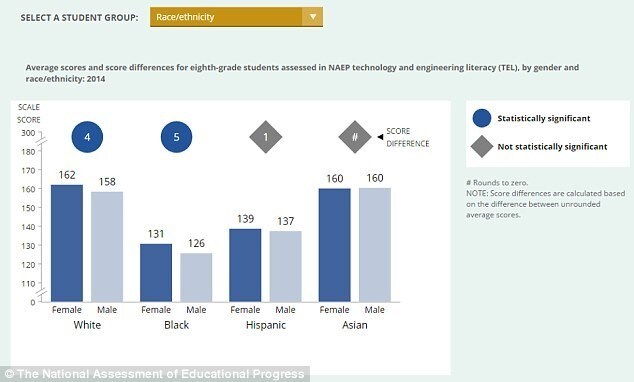
Technology might be a male-dominated field, but teenage girls appear to be proving they are better at the subject than boys. A 2014 study of US students by the National Assessment for Educational Progress has shown that girls are outperforming boys in technology and engineering literacy.
Over 20,000 13-14 year olds were tested on their ability to solve problems about real-world scenarios, focusing on three areas: technology and society, design and systems, and information and communication technology.
Overall, 45% of girls proved proficient, compared with only 42% of boys. The results contradict previous research showing that girls usually perform worse than boys in mathematical and scientific subjects, such as technology and engineering.
For Peggy Carr, acting commissioner of the National Center for Education Statistics, there is no ambiguity in the results. “Girls have the ability and critical thinking skills to succeed in fields of technology and engineering,” she said.
As this test shows, girls and women have the skills and knowledge to succeed in STEM industries. However, they are still underrepresented in the technology sector, as well as across STEM fields.
Where are the women in tech?
The gender gap across both tech and other STEM industries is wide, with women making up only 26% of the STEM workforce in developed countries. In developing countries, the figure is even lower.
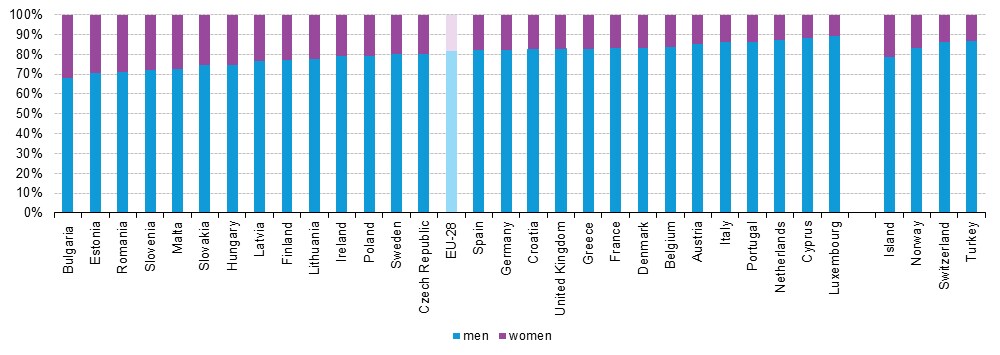
In Europe, women make up only 30% of the 7 million people working in the digital sector. They are especially underrepresented in decision-making roles and specialist positions.
This chart shows the gender of ICT specialists in European countries in 2014.
Although women were initially heavily involved in the development of computer science, technology soon began to be perceived as a “man’s world”, discouraging women from moving into the sector.
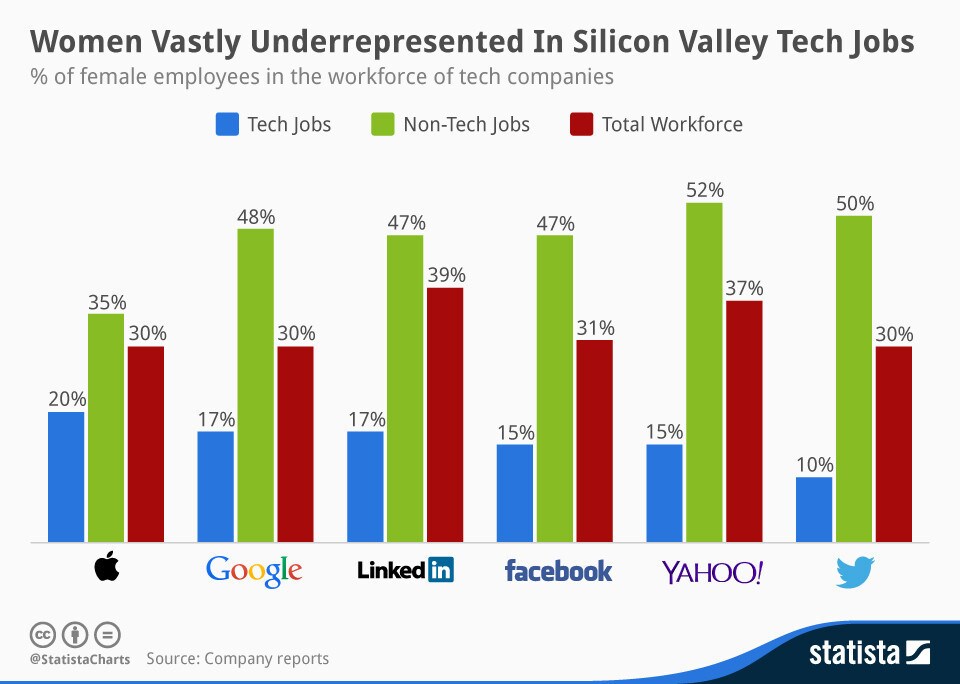
Today women make up less than 40% of the overall workforce in many of the world’s leading tech companies, a number that is even lower when looking at tech-related roles.
What’s stopping girls going into tech?
Women view the technology sector as male-dominated and this is putting them off entering the field, according to the International Communication Union.
Another study, from the University of Texas, says gender stereotypes and societal structures are the reasons why more women don’t go into STEM industries.
“All the evidence points to obstacles and discouragement for women going into STEM fields,” Meg Urry, chair of the physics department at Yale University, said.
Speaking about the recent test results, Tonya Matthews, president and CEO of the Michigan Science Center said: “The scores clearly show that when students have opportunities to engage with technology and engineering, they become fluent in the skills that prepare them for living and working in the modern world.”
The Girls in ICT initiative encourages young women to enter the tech sector; it also emphasizes the need for more women in ICT.
“Not only are jobs in the ICT sector lifting women out of poverty; a more gender-balanced sector offers fulfilling mid and high-level careers, and enables highly talented women to springboard to the top of the career ladder,” the initiative founders state.
Have you read?
Where are the women in tech? In 3 charts
How to close the diversity gap in Silicon Valley
A revolution for gender parity?