A weekly digest of stories about how the gender gap plays out around the world – in business, health, education and politics.
Is the gender pay gap really the result of discrimination? (World Economic Forum)
Where the US gender pay gap is widest: in working class communities. (Bloomberg)
Taking the “man” out of the US Marine Corp. 19 job titles change. (Quartz)
Transforming one of the most male-dominated industries in the world. (World Economic Forum)
Google’s diversity stalls, but women in leadership roles are up. A bit. (Money)
Low cut or covered up? One is five times more likely to get you a job interview. (The Guardian)
Ramadan TV dramas aren’t doing much for Egyptian women. (Al-Monitor)
Correcting the digital gender gap. (World Economic Forum)
Venture capital for women-led start ups in health doubles. Now it’s a fifth. (Bloomberg)
‘Don’t touch me’ wristbands to fight sexual assault in Sweden. (RT.com)
Where owning land can be the difference between life and death for single women. (Thomson Reuters Foundation)
Venus Williams calls out Wimbledon sexism. Gently. (New York Magazine)
Chinese women use social media to challenge sexual assault. (BBC)
It’s not marriage, it’s housework that is bad for women’s health. (The Spectator)
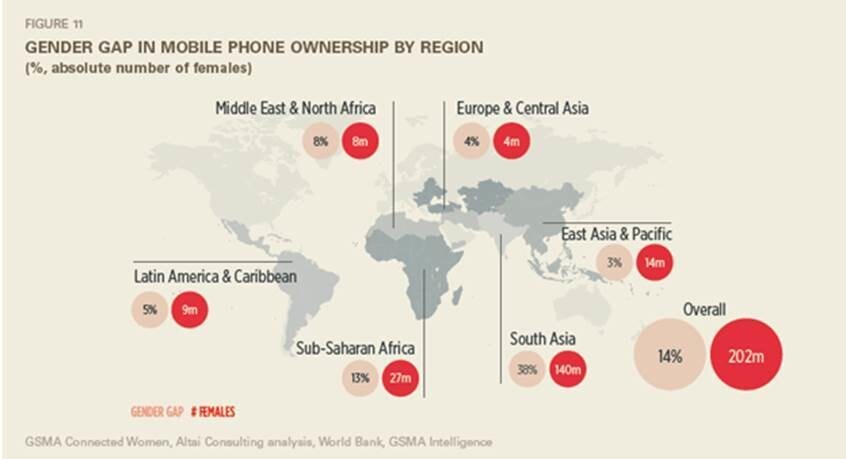
Statistics of the week: The gender gap and mobile phone usage
Women are 38% less likely to own a phone than men in South Asia.
Women in Niger are 45% less likely to own a mobile phone.
In Mexico’s urban areas, the gender gap in mobile phone ownership in urban areas is 2%, but rural women are 26% less likely to own a phone than rural men.
Connected Women Programme
The GSMA Foundation
Chart of the week: The digital gender gap and mobile phone ownership globally
Quote of the week
“In my experience, women work hard to create a more just and equal society—when they are given the chance. If that was more often the case, and women were not simply called in to do the cleaning up when the men have made a mess of things, I think the world would become a better place.”
Jóhanna Sigurðardóttir, Prime Minister, Iceland
Newsweek