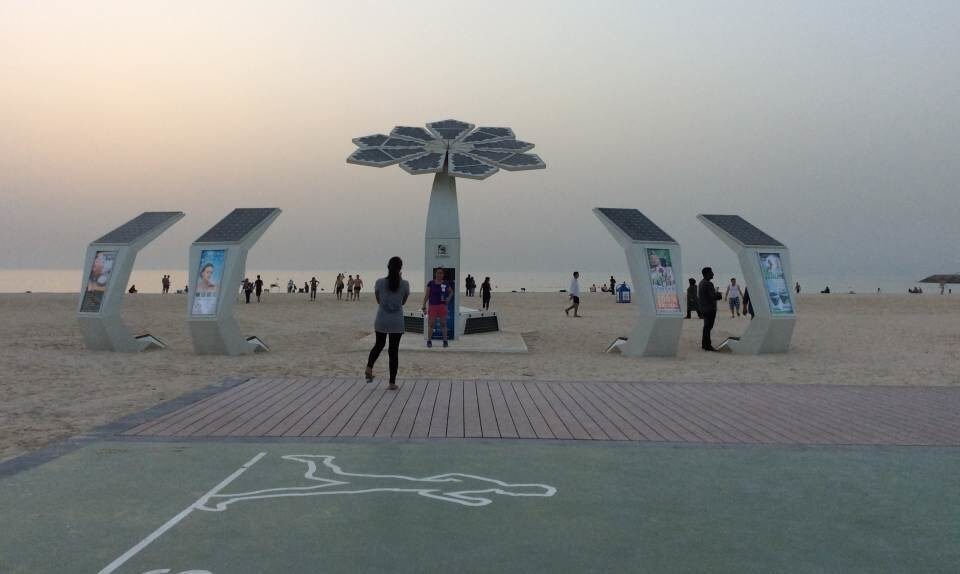
A new species of palm tree has started sprouting around Dubai. But instead of producing dates, the fronds of the Smart Palm harness the sun’s energy to allow people to look up city information, access Wi-Fi, and charge their phones, all for free.
Topped with nine leaf-shaped photovoltaic modules, a six-meter-tall Smart Palm can generate around 7.2 kilowatt-hours per day, enough to operate without ever drawing off the grid.
Smart Palm solar trees, dotting Dubai's landscape
The two prototype palms that have already been installed – one at a beach near the Burj Al Arab hotel and the other at centrally located Zabeel Park – each carry a Wi-Fi hotspot, eight charging stations for phones and tablets, and a touch-screen panel giving local details on the things like weather and transportation.
The company behind the device, Dubai-based D Idea, says connectivity is just the start of the Smart Palm’s potential.
“Subsequent Smart Palms will have ATM machines and utility bill payment services,” said CEO Viktor Nelepa. “Our team has also started to find new ways in which the Smart Palm can support other forms of sustainable generation, specifically through air and water purification modules.”
Over the next 12 months, D Idea plans to install 103 Smart Palms across the city of Dubai.
The next generation of the device, due to be launched in September, will be created by a 3D printer and have a different design.
Made from a combination of fiber-reinforced plastic and concrete, the new Smart Palms will also be better able to withstand Dubai’s tropical desert climate.
“The device will not only look attractive but would counter the extreme weather conditions,” Nelepa said.
Nelepa would not say how much the palms cost, but said the company plans to turn to advertising and branding to meet future costs, he said.
Smart Palms: a green Innovation
According to Nelepa, the Smart Palm project is one of several initiatives that are part of Dubai’s push to create a greener economy.
Its Smart City plan, Green Economy Initiative, and the United Arab Emirates’ declaration of 2015 as the “Year of Innovation” all aim to make Dubai one of the world’s most connected and increasingly sustainable cities within the next few years.
Earlier in 2015, the Dubai Electricity and Water Authority announced it was tripling its target share of renewables in Dubai’s energy mix from 5 percent to 15 percent by 2030.
Meanwhile, the city has already re-launched Al Khazan Park as the first Dubai park to run completely on solar power and is moving ahead with plans to build the Desert Rose, a sustainable city for a population of 160,000.
In a country where 88 percent of the population uses their phones to access the internet, the Smart Palm already has fans.
“The device is actually useful as we spent almost four hours on the beachfront today and that’s enough to drain my battery,” said Nawaf Al Qinae, a professional photographer from Kuwait, as he rested on a sun lounger while waiting for his phone to charge at the beach near the Burj Al Arab.
But others want more from the Smart Palm solar trees.
“Every evening I run on the jogging track and see hundreds of people doing the same to keep fit,” said Mohammed Hashim, getting ready for his run along the beach. “I wish there were drinking-water filters attached to the solar panels to help runners.”
This article is published in collaboration with Thomson Reuters Foundation. Publication does not imply endorsement of views by the World Economic Forum.
To keep up with the Agenda subscribe to our weekly newsletter.
Author: Saket S. is a business analyst and freelance contributor for the Thomson Reuters Foundation.