When China unveiled the Sunway TaihuLight in June 2016, it became the fastest supercomputer in the world. It easily surpassed the previous record holder, Tianhe-2. It’s almost three times as fast. But now, the title it has held for less than a year is under threat, with the Japanese planning to build something even faster.
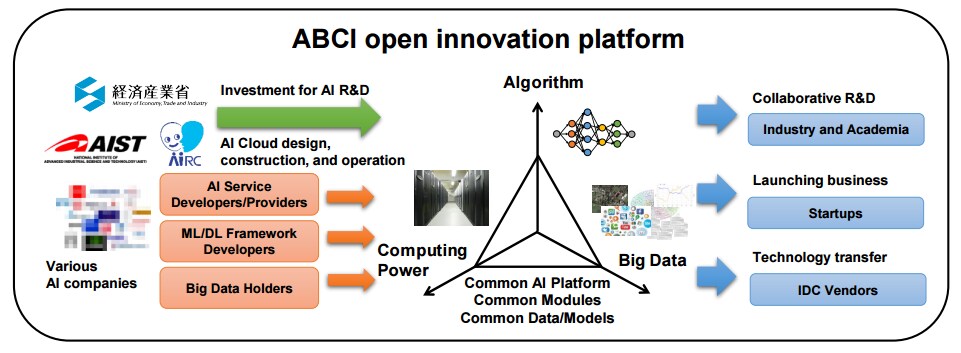
The Ministry of Economy, Trade and Industry plans to invest 19.5 billion yen ($172 million) in the new machine, as part of an attempt to revitalise Japan’s electronics industry and reassert Japan's technical dominance.
Recent years have seen Japan's lead challenged by competition from South Korea and China, but the Japanese government hopes to reverse that trend.
Immense computing power
The new machine, called the AI Bridging Cloud Infrastructure, or ABCI, is designed to have a capacity of 130 petaflops. That means it will be able to perform 130 quadrillion calculations a second. Still confused? Well for the sake of easy comparison, that’s equal to the computing power of 70,652 Playstation 4s.
As well as out-computing the current Chinese machine it will also be nearly ten times as fast as the Oakforest-PACS, the current fastest Japanese supercomputer, whose 13.6 petaflops will be dwarfed by those of the new machine.
“As far as we know, there is nothing out there that is as fast,” said Satoshi Sekiguchi, director general at Japan's National Institute of Advanced Industrial Science and Technology.
Perhaps the most ambitious aspect of the proposed machine, though, is its hyper-efficient power consumption. The computer’s designers are aiming for a power consumption of fewer than three megawatts. This would be five times lower than the TaihuLight, and the same as the Oakforest-PACS, the output of which is ten times lower.
The applications
While other countries have optimized their most powerful computers for processes such as atmospheric modeling or nuclear weapon simulations, AIST aims to use the new machine to accelerate advances in AI technology.
ABCI could help companies improve driverless vehicles by analyzing vast amounts of traffic data. According to Sekiguchi, the supercomputer could also be used to mine medical records to develop new services and applications.
The computer will also be made available to Japanese corporations for a fee, said Sekiguchi, alongside others involved in the project. Japanese companies currently outsource their major data-crunching to foreign firms such as Google or Microsoft.
The future
Japan hopes that ABCI will be operational by 2018, whereupon it will take the top spot on the TOP 500’s ranking list of supercomputers.
It might not stay there for very long, though. The computer manufacturer Atos has already begun work on the Bull sequana supercomputer for the French Alternative Energies and Atomic Energy Commission (CEA). This machine is projected to have a performance of one exaflop, meaning that it will be able to perform a billion billion calculations a second - almost seven and a half times faster than the ABCI.
The French machine won't be operational until 2020 however, meaning ABCI should still enjoy a spot in the supercomputing limelight.