Try gift-wrapping a soccer ball, and you will quickly encounter the geometric abyss between paper’s inherent flatness and a sphere’s natural curves.
“The very first bit seems to sort of match, but as you wrap the paper around, the crinkles get bigger and bigger,” observed Toen Castle, a physicist at the University of Pennsylvania.
With their concave curves, saddles are equally tough to wrap, but for the opposite reason. “There’s more saddle than there is paper,” Castle said.
The mismatch between soccer balls, saddles and sheets of paper lies in their “intrinsic” curvature, a property of surfaces known to mathematicians for centuries that no amount of folding can change. Scientists have sought a bridge across the divide — a systematic way of imbuing flat surfaces with curvature, which they say could revolutionize the design and assembly of three-dimensional structures and help extend a major theorem of geometry.
To read more, go to the Quanta Magazine website.
This article is published in collaboration with Quanta Magazine. Publication does not imply endorsement of views by the World Economic Forum.
To keep up with Forum:Agenda subscribe to our weekly newsletter.
Author: Natalie Wolchover is a staff writer at Quanta Magazine covering the physical sciences.
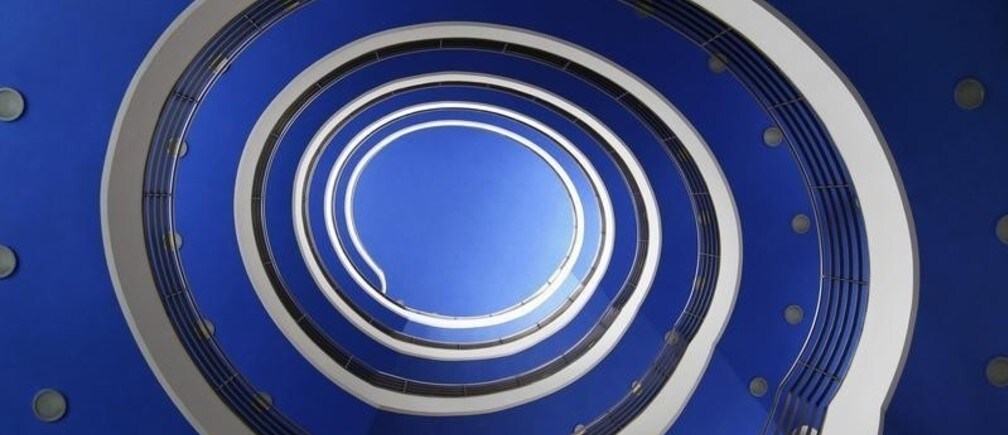
Image: A staircase looking like a snail is pictured in a Munich building ‘Haus der Bayrischen Wirtschaft’ on February 14, 2012. REUTERS/Michaela Rehle.