An estimated one in 10 people worldwide have dyslexia, a learning difficulty that primarily affects reading and spelling ability. For the 90% that don’t have it, it can be hard to understand what it’s like.
Determined to rectify this, online developer Victor Windell created a website, shown in the below visualization, to give people insight into what it's like to have the condition.
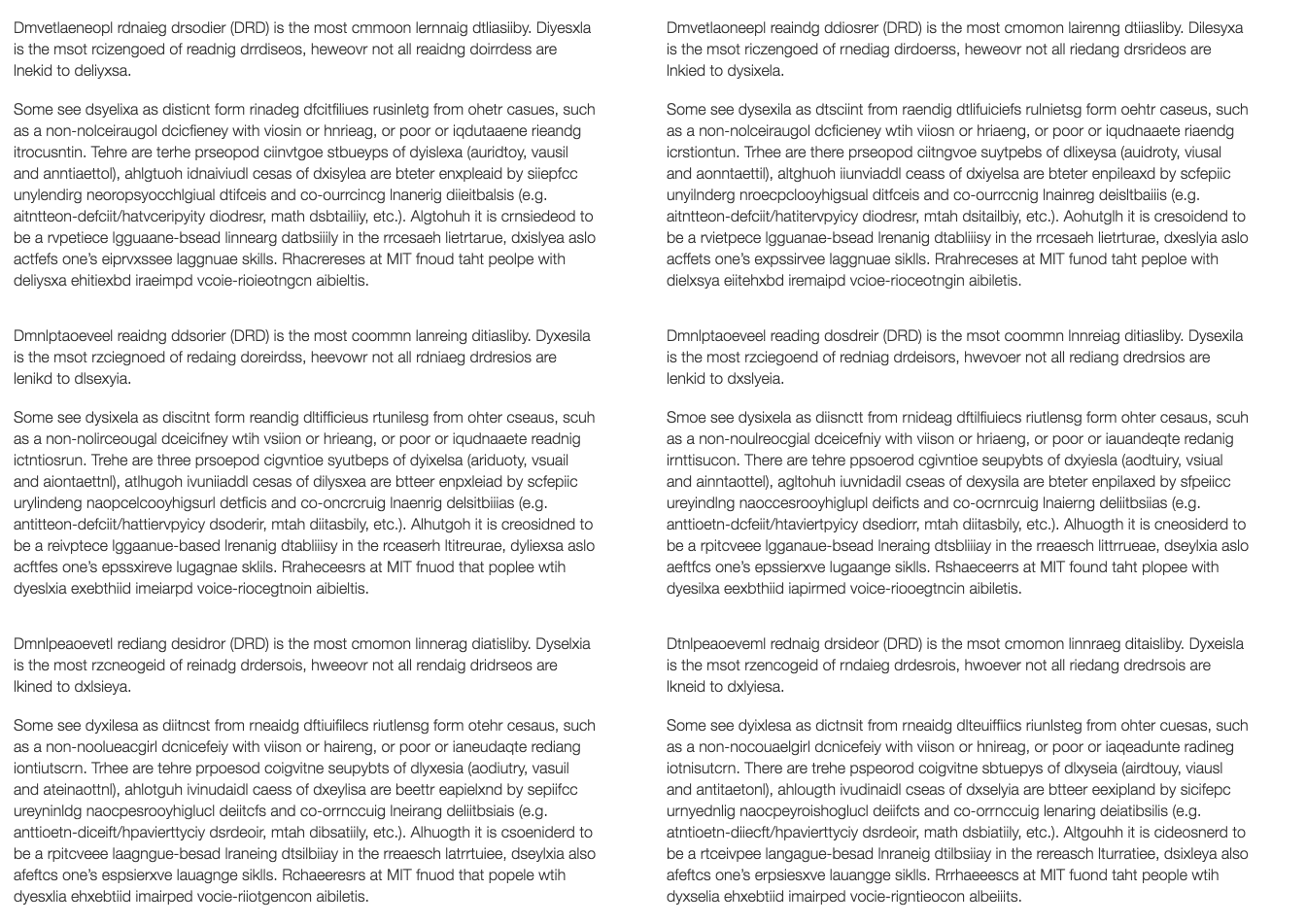
Source: Victor Windell
“I remembered a conversation I had a long time ago with a dyslexic friend,” Windell says. “Out of curiosity, I asked about how she experiences reading. She explained it as the letters jumping around.” This prompted Windell to create the simulation, which makes letters and words move around on the page, becoming much more difficult to make sense of.
Dyslexia is not the same for everyone; it varies from mild to severe, and is sometimes linked to other learning difficulties. What it's not linked to is general intelligence, says Luz Rello of Carnegie Mellon University. Rello, who studies dyslexia and is dyslexic herself, adds: “It’s also universal; you see it in every language.”
She notes that Windell’s code doesn’t fully demonstrate the struggles of people with dyslexia. “Instead of jumbling the text, I would add real words that are phonetically similar and orthographically similar to other words that are real.”
British organization Dyslexia Action notes that the problem isn’t limited to written words. Many people with dyslexia also experience difficulty with speech, especially when under pressure. “It is wrong to think of dyslexia as just a reading problem. Many people with dyslexia can become quite good readers, whilst others may read slowly with inaccuracies,” states the organization on its website.
But dyslexia is no cause for despair, the statement continues: "With the right help and support, strategies to overcome difficulties associated with dyslexia can be learnt and dyslexia need not be a barrier to achievement."
Have you read?
10 strategies quick learners use to pick up anything
What the digital age means for people with disabilities
Do creative people have different brains?