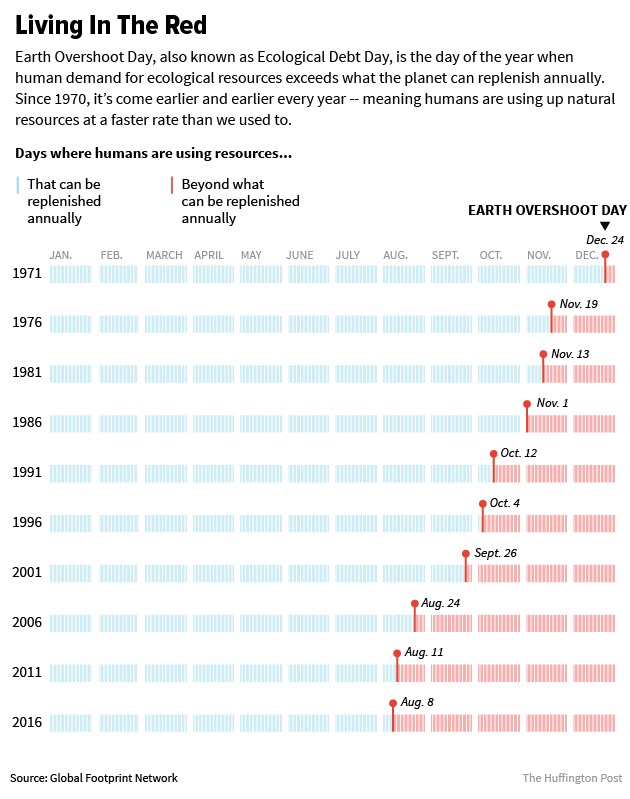
Just eight days into August and we’ve already used an entire year’s worth of resources – the amount that the Earth can replenish annually.
As this Huffington Post graphic shows, so-called ‘Earth Overshoot Day’ has been getting earlier and earlier every year, highlighting our rapidly increasing use of resources.
It’s fallen five days earlier this year than it did in 2015. In 1971, it fell on 24 December.
One Earth isn’t enough
Our increasing use of the world’s resources is putting life on Earth at risk.
A failure to live sustainably and within our means will not only have a negative impact today, but is likely to have consequences far into the future. As the World Wildlife Fund has highlighted, “for the remainder of 2016, we will be living on resources borrowed from future generations.”
In fact, to sustain our current levels of consumption, this year we would have needed the equivalent of 1.6 Earths. But, some countries are worse than others, as this graphic from the Global Footprint Network (the think-tank behind Earth Overshoot Day) shows.
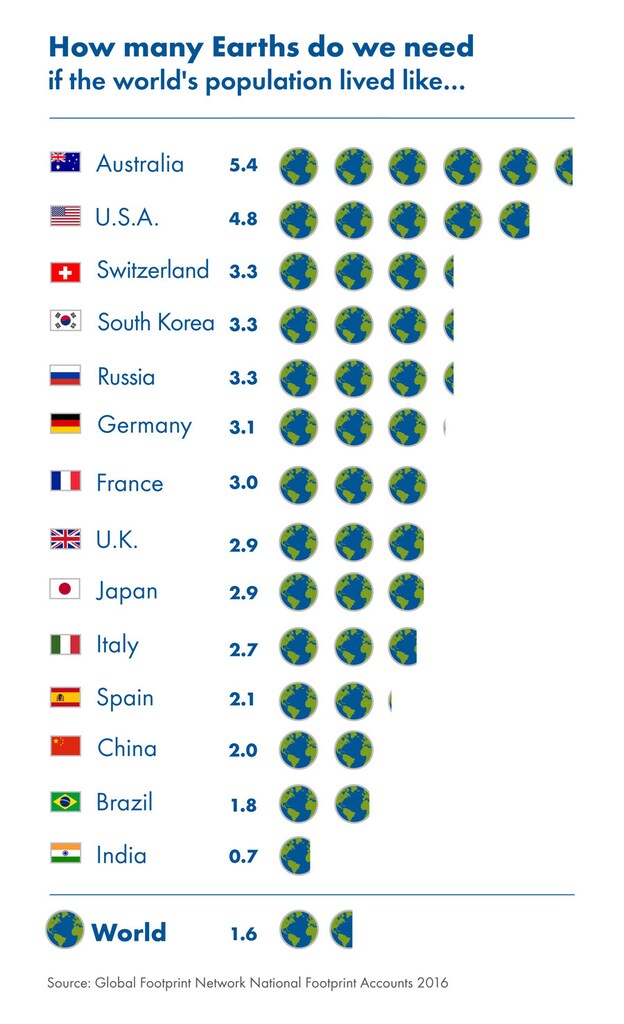
The list is dominated by developed nations, with Australia topping the list. If we all lived like Australians, we’d need the equivalent 5.4 Earths every year.
“We’re depleted what our planet does for us, so year after year, there is less for us to use,” explained Stuart Pimm, Doris Duke Professor of Conservation Ecology at Duke University’s Nicholas School of the Environment, to National Geographic. “Less forest, fewer fish in the ocean, less productive land – burdens that fall disproportionately on the world’s poor.”
In ecological debt
A similar picture emerges when you look at the situation on a country-by-country basis.
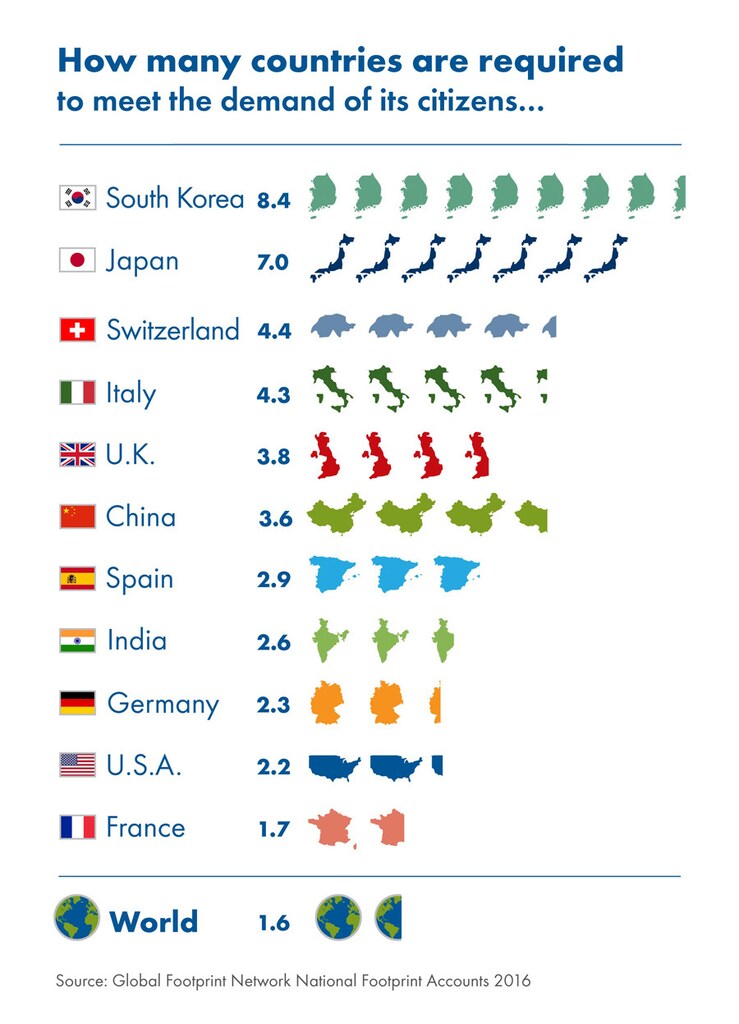
South Korea has the biggest ecological debt of all countries on the list. It needs the equivalent of over eight of itself to meet the demands of its citizens.
Have you read?
Resource efficiency: lessons from Henry Ford on doing more with less
What are the Sustainable Development Goals?